 Jambolaya

Triangles
How to play
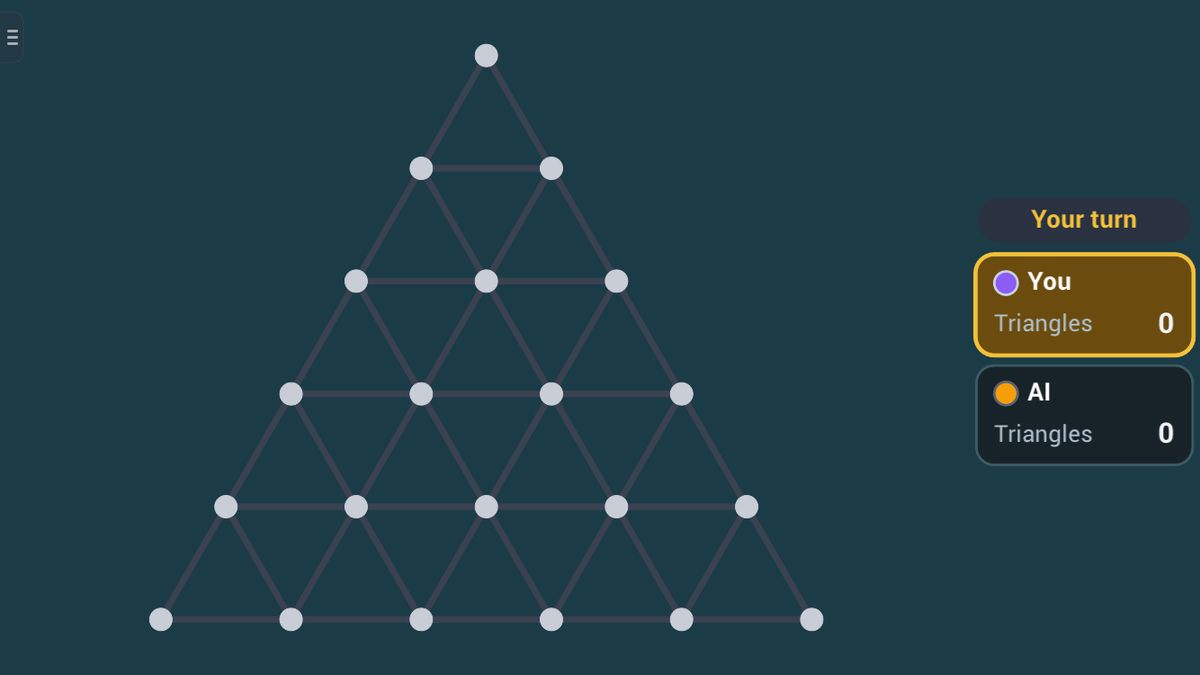
Take turns drawing one line between two adjacent dots on the triangular grid. Complete the third side of a small triangle to claim it and immediately take another turn. When every triangle is claimed, whoever owns the most wins.
The aim
The board is one big triangle of dots: one dot at the top, then a row of two, then three, down to six along the bottom. Between the dots sit 25 small triangles. Two players, Purple and Orange, take turns drawing short lines between neighbouring dots. Whoever draws the third side of a small triangle wins it. When all 25 are taken, the player who owns more wins.
How a turn works
- Purple draws first. Against the computer, whoever starts plays Purple.
- Pick two dots that sit next to each other and draw the line between them. A line can run flat, or slant down to the left or to the right.
- If your line finishes no triangle, your turn is over.
- If it finishes a triangle, the triangle fills with your colour and you must draw again straight away.
- One line can finish two triangles at once, when the triangles on both sides were waiting for it.
You are never forced to finish a triangle. You may always draw somewhere else.
A small example. You draw one side of the topmost triangle. Orange then draws a second side of that same triangle. Only one side is missing now, so you draw it, win the triangle, and draw again. This time you pick a line that touches no triangle with a side already drawn.
Scoring and the end of the game
Each triangle is one point. The game ends when the last triangle is claimed, and more triangles wins. Because 25 is odd, one player always has at least 13, so there is never a tie.
Tips to play better
- The second side is the gift. A triangle has only three sides, so once it has two, the next player can take it. Avoid drawing a triangle's second side.
- Check all three directions. Triangles point up and down, and their sides slant both ways. Look at every triangle beside your line.
- Spend safe lines slowly. A line is safe when neither triangle beside it has a side yet. Later every line gives something away, and whoever runs out of safe lines first usually loses.
- Outside lines touch only one triangle. An inside line borders two. When you must give something away, an outside line often gives less.
- See the chains. Taking one triangle can leave its neighbour waiting for its last side, so one turn can sweep up a whole row.
- Look for double captures. A line between two triangles that both have two sides wins both.
Common mistakes
- Drawing a second side because the triangle still "looks far from done". Your opponent only needs the third.
- Forgetting that a capture means another line. After your last capture you still have to draw, and that line can be a gift.
- Checking only the flat lines and missing the slanted ones.
Playing with family
Triangles has one simple rule and needs no reading, so a child of eight can play a grandparent as an equal. The triangular grid makes everyone count carefully.
In Jambolaya you can play against the computer on Easy, Normal or Hard, choose who starts, and play a single game or a best of 3 or 5. Easy often draws careless lines, which suits a beginner. On Hard the computer takes every triangle it can and gives nothing away while a safe line remains. The guided lesson lets you claim your first triangle, take the extra turn and find a safe line, then teaches the golden rule about the second side. It ends by showing a lost game and letting you draw the last line of a win.
In the app, two people can also play together nearby, each on their own phone or tablet, with no Wi-Fi or internet needed. The browser edition plays on one device.
Ways to play
- Against the computerPlay on one device against a computer opponent.
- Play together, nearbyOne-on-one with someone in the same room, each on your own phone or tablet. No Wi-Fi or internet needed. In the Jambolaya app.
- Learn by playingA guided lesson on the real game teaches you the rules one step at a time.
 Fanorona1–2 players
 Pig1–4 players
 Farkle1–6 players
 Shut the Box1–4 players
 Liar's Dice1–6 players
 Dominoes1–4 players
 Reversi1–2 players
 Four-in-a-Row1–2 players