 Jambolaya
Reversi
How to play
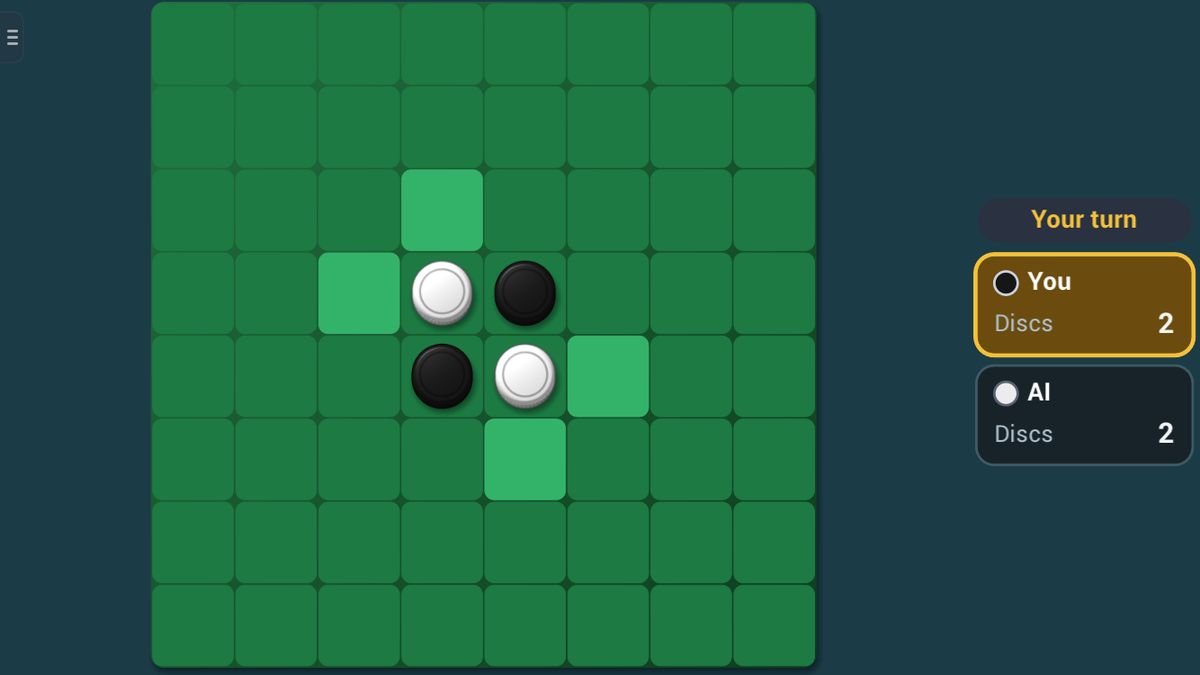
Take turns placing a disc of your colour. A legal move must trap one or more of the opponent's discs in a straight line — horizontal, vertical, or diagonal — between the disc you place and another of your own; every trapped disc flips to your colour.
If you have no legal move you pass. When the board fills or neither side can move, the player with the most discs wins.
The aim
Reversi is played on a board of 8 by 8 squares with discs that are black on one side and white on the other. Black and White take turns adding discs, and every move turns some of the other player's discs over to your colour. When neither player can move, whoever has more discs of their colour wins.
How a turn works
The game starts with four discs in the middle, two of each colour, placed corner to corner. Black moves first.
- Place one disc of your colour on an empty square.
- The move must trap at least one enemy disc. Trapped means a straight line of enemy discs, with your new disc at one end and one of your own discs at the other.
- Lines can go across, up and down, or corner to corner.
- Every trapped disc flips to your colour. One move can trap discs in several directions at once, and all of them flip.
On your turn, every square where you may play glows, so you never have to hunt for a legal move.
If you have no legal move at all, your turn is skipped and the other player goes again.
A small example. A white disc sits just above one of your black discs. You place a black disc on the empty square above the white one. The white disc is now trapped between two black ones, so it flips to black. On the next turn, White may flip it straight back.
Scoring and the end of the game
The game ends when neither player can move. Usually that is because the board is full, but it can happen sooner. If one player loses every disc, the game is over on the spot.
Count the discs. The colour with more discs wins. If both players have the same number, the game is a draw.
Tips to play better
- Take the corners. A disc in a corner can never be flipped. It also helps protect the discs beside it along the edges.
- Avoid the squares next to an empty corner. Especially the square diagonally next to it. Playing there often hands the corner to your opponent.
- Edges are steadier than the middle. Edge discs can only be flipped along the edge, not from every side.
- Flip fewer discs early. Grabbing lots of discs early gives your opponent more places to play. Fewer flips can leave them with only bad moves.
- Count your opponent's choices. A good move often leaves them with few glowing squares, or none, so they must pass.
Common mistakes
- Counting discs in the middle of the game and grabbing the move that flips the most.
- Playing next to an empty corner and giving the corner away.
- Forgetting that a single move flips in every direction at once, including lines you did not notice.
- Giving up when far behind. A late corner or a forced pass can turn a whole edge.
Playing with family
Reversi takes a minute to learn: place a disc, flip the trapped ones. Children love watching a row of discs change colour, and nobody has to remember how pieces move. Older players will find plenty of depth.
In Jambolaya you can play against the computer on Easy, Normal or Hard. You choose who starts, which also chooses your colour: start first and you play Black. You can play a single game or a best of 3 or 5. Easy often makes careless moves, while Hard looks far ahead. The guided lesson lets you make your first capture and a free move, then flip every white disc with a single move, and finally shows a loss with a tip about corners.
In the app, two players can also play together nearby, each on their own phone or tablet, with no Wi-Fi or internet needed. The browser edition plays on one device.
Ways to play
- Against the computerPlay on one device against a computer opponent.
- Play together, nearbyOne-on-one with someone in the same room, each on your own phone or tablet. No Wi-Fi or internet needed. In the Jambolaya app.
- Learn by playingA guided lesson on the real game teaches you the rules one step at a time.
 Four-in-a-Row1–2 players
 Five-in-a-Row1–2 players
 Tic-Tac-Toe1–2 players
 Checkers1–2 players
 Chess1–2 players
 Dots & Boxes1–2 players
 Ship Battle1–2 players
 Backgammon1–2 players