 Jambolaya

Tic-Tac-Toe
How to play
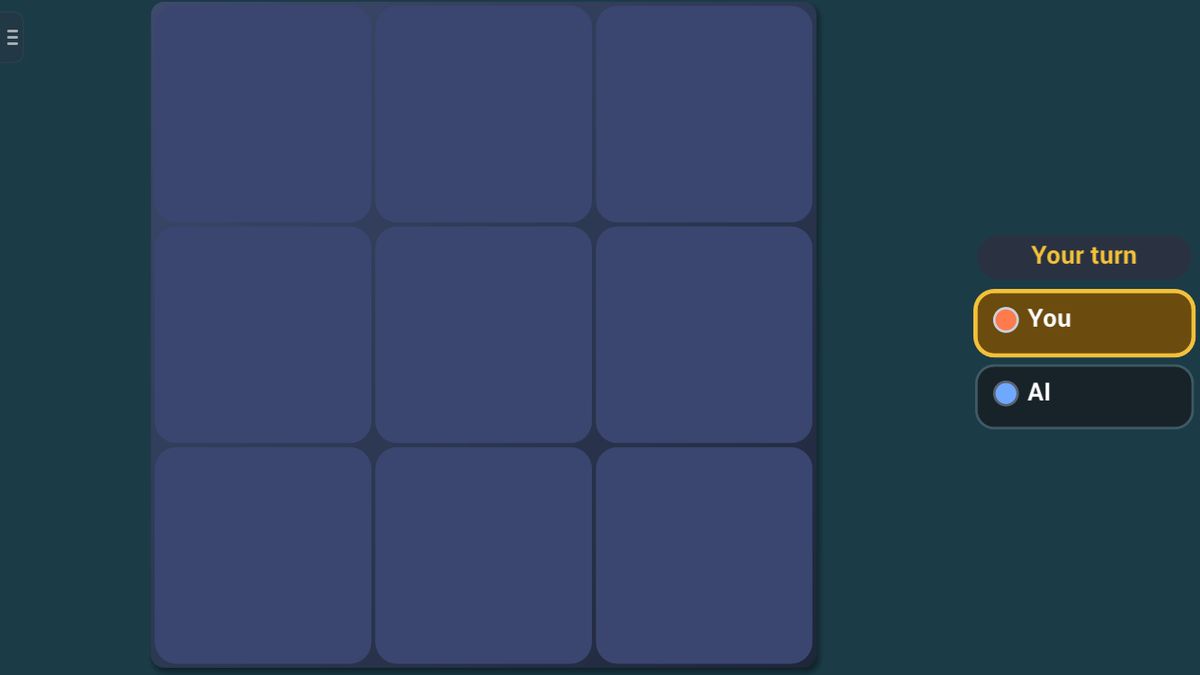
Take turns marking a square with your X or O. The first to line up three in a row — horizontal, vertical, or diagonal — wins. Fill all nine squares with no line and it's a draw.
The aim
Tic-Tac-Toe is played on a grid of nine squares, three across and three down. One player is X and the other is O. You take turns putting your mark in an empty square. The first player to make a straight line of three of their own marks wins: across, down, or corner to corner.
How a turn works
- X always moves first. Against the computer, whoever starts plays X.
- On your turn, tap any empty square. Your mark appears and the turn passes.
- A mark never moves once it is down, and you cannot skip a turn.
- The game stops the moment someone makes a line of three, or when all nine squares are full.
A small example. You are X and take the centre. O answers on an edge, the middle square of one side. You take a corner, so you have two marks on a diagonal. O must block the far corner, or you win next turn. Now look for a square that makes two new lines of two at once. O can block only one of them, and your next mark finishes the other.
Scoring and the end of the game
There are no points. Either one player makes three in a row and wins, or the board fills up with no line and the game is a draw. Between two careful players most games are draws, so a win usually comes from a mistake.
Against the computer you can play a single game, or a best of 3 or 5.
Tips to play better
- Start in the centre. It sits on four lines: one across, one down and both diagonals. A corner sits on three, an edge on only two.
- Block first, then attack. Before every move, look for a line where your opponent has two marks and the third square is empty. Fill it.
- Build a fork. A fork is one mark that makes two lines of two at once. Your opponent can only block one.
- If X starts in a corner, take the centre. Any other answer lets X force a win.
- If X starts in the centre, answer in a corner, never on an edge. The edge is exactly what lets X build a fork.
- Watch the opposite-corner trap. If you hold the centre and X holds two opposite corners, play on an edge. A third corner hands X a fork.
Common mistakes
- Chasing your own line and forgetting to block a two already on the board.
- Answering a centre opening with an edge square.
- Relaxing near the end. Even with two or three squares left, one careless mark can let your opponent finish a line.
Playing with family
Tic-Tac-Toe is often the first strategy game a child learns. A round takes about a minute, the rules fit in one sentence, and a young player can beat a grown-up who is not paying attention. Older players can teach the centre, the block and the fork, one idea at a time.
In Jambolaya you can play against the computer on Easy, Normal or Hard, choose who starts, and play one game or a best of 3 or 5. Easy often puts its mark on a random square, which gives beginners real wins. Hard never makes a mistake, so the best anyone can do against it is a draw. The guided lesson first shows a game lost by leaving an open two, then lets you win one with your own taps: the centre, a diagonal, and a fork.
In the app, two people can also play together nearby, each on their own phone or tablet, with no Wi-Fi or internet needed. The browser edition plays on one device.
Ways to play
- Against the computerPlay on one device against a computer opponent.
- Play together, nearbyOne-on-one with someone in the same room, each on your own phone or tablet. No Wi-Fi or internet needed. In the Jambolaya app.
- Learn by playingA guided lesson on the real game teaches you the rules one step at a time.
 Checkers1–2 players
 Chess1–2 players
 Dots & Boxes1–2 players
 Ship Battle1–2 players
 Backgammon1–2 players
 Mancala1–2 players
 Nine Men's Morris1–2 players
 Hex1–2 players