 Jambolaya
Backgammon
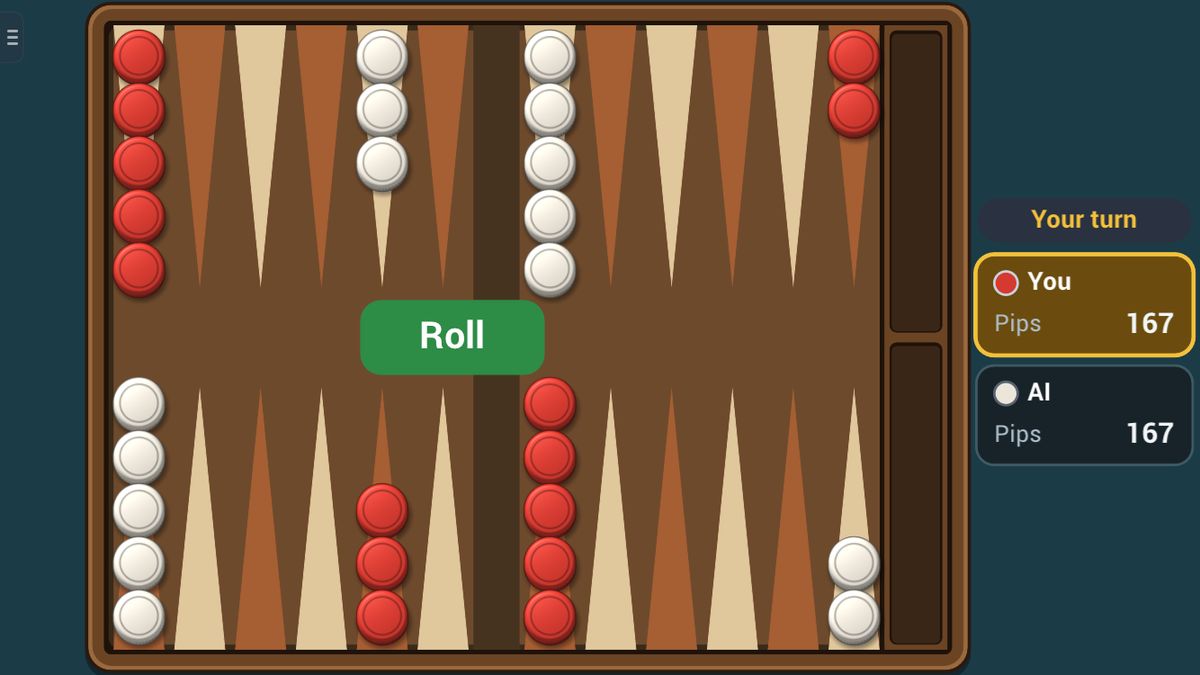
How to play
Roll two dice and move your checkers toward your home board, using each die as a separate move. You may land anywhere except a point held by two or more enemy checkers; landing on a lone enemy checker sends it to the bar to re-enter.
Once all your checkers are home, bear them off — the first to bear off all fifteen wins. In a match to N points a win scores 1, a gammon (the loser has borne off none) 2, and a backgammon (…and still has a checker on the bar or in the winner's home board) 3.
Before rolling you may double: if your opponent accepts, the game is worth twice as much and they hold the cube; if they decline, they lose the current stake. The first game in which a player needs just one more point is the Crawford game: no doubling.
The aim
Each player has 15 checkers on 24 long triangles, called points, and the two sides travel in opposite directions. Bring all 15 of your checkers into your home corner, the last six points of your track, then take them off. The first player to take off every checker wins.
How a turn works
Red always moves first; there is no opening roll. Against the computer you pick who starts.
- Tap Roll to throw your two dice.
- Each die is its own move. Tap a checker, then a lit point where it can land.
- Move two different checkers, or the same checker twice.
- Roll a double, like two fours, and you play that number four times.
A point held by two or more enemy checkers is blocked; you may land anywhere else.
Example: you roll a 3 and a 1. Move one checker three points and another one point so both land on the same empty point. Now your opponent cannot land there.
Landing on a lone enemy checker hits it. It goes to the bar, the strip in the middle, and must come back in at the start of its track before any other checker of that colour may move. If it has nowhere to come in, the turn passes.
You must keep playing while any die can be used; a die that cannot be played is lost. (Strict rules also force the larger die in some cases. The app does not.)
Scoring and the end of the game
With all 15 home, tap a checker, then your tray. A die that matches the distance takes a checker off. A bigger die works too, but only when no checker of yours sits farther back.
You play a match to a number of points, from 1 to 100. A normal win scores 1. If the loser has not taken off a single checker, it is a gammon, worth 2. If the loser also still has a checker on the bar or in the winner's home corner, it is a backgammon, worth 3. First to reach the target wins the match.
In a match longer than one point there is a doubling cube. On your turn, before you roll, you may tap Double. If your opponent accepts, the game is worth twice as much, and only they may double next. If they decline, you win the game at its old worth. The first game in which either player needs just one more point is the Crawford game: no doubling in it.
Tips to play better
- Make points by putting two checkers together, especially in your home corner. Each one is a wall.
- Avoid lone checkers six points or less in front of enemy checkers. That is the danger zone.
- Six of your points in a row form a full wall that no checker can pass.
- Watch the pip counts beside the board. The lower number is ahead in the race.
- Far behind in the race? Hitting is often your best chance.
- Accept a double if you still have a fair chance. Decline when a gammon looks likely.
Common mistakes
- Rushing home and leaving lone checkers that are easy to hit.
- Forgetting that a checker on the bar must come in before anything else moves.
- Piling checkers on one point instead of spreading them to block more.
- Getting hit while taking checkers off. You cannot take off again until that checker is home.
Playing with family
Luck and choices mix, so a child can beat a grandparent on a good roll. Lit points show where a checker can land.
Play against the computer on Easy, Normal or Hard. The guided lesson shows rolling, hitting, taking checkers off and the cube. In the app, two players can also play together nearby, each on their own phone or tablet, with no Wi-Fi or internet needed.
Ways to play
- Against the computerPlay on one device against a computer opponent.
- Play together, nearbyOne-on-one with someone in the same room, each on your own phone or tablet. No Wi-Fi or internet needed. In the Jambolaya app.
- Learn by playingA guided lesson on the real game teaches you the rules one step at a time.
 Mancala1–2 players
 Nine Men's Morris1–2 players
 Hex1–2 players
 Go1–2 players
 Race Home1–4 players
 Snakes & Ladders1–4 players
 Chinese Checkers1–6 players
 Chinese Chess1–2 players