 Jambolaya
Go
How to play
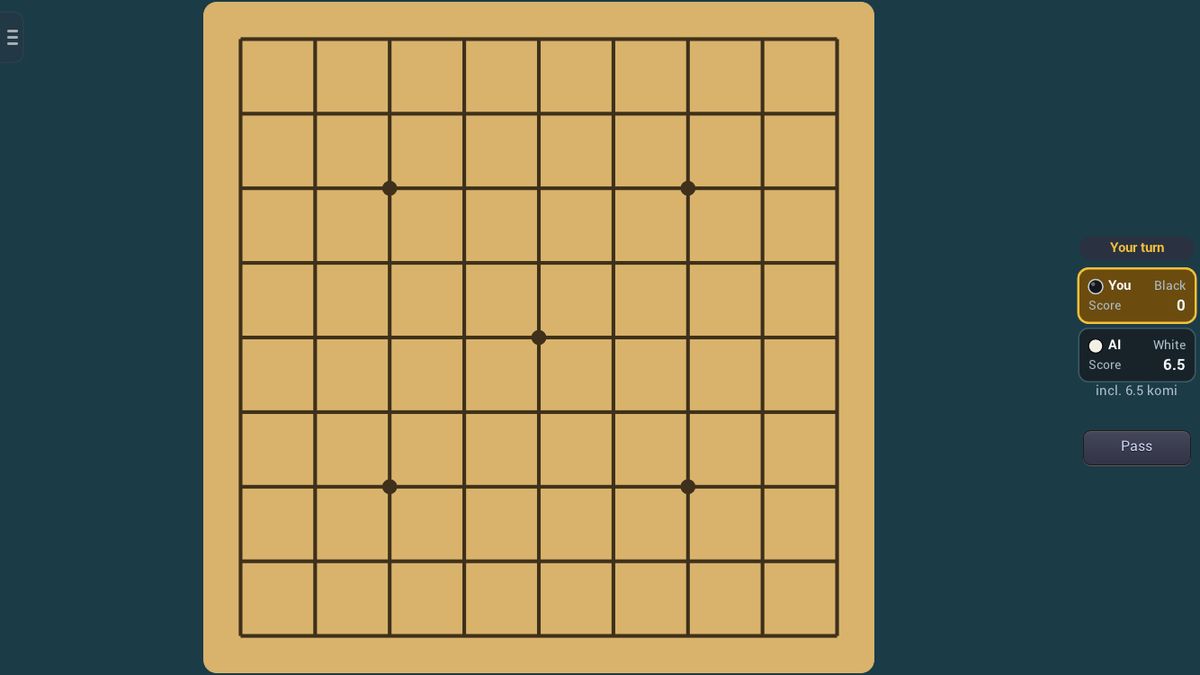
Take turns placing a stone on an empty intersection of the 9×9 board (Black first). A group of connected stones with no adjacent empty point — no liberties — is captured and removed.
You can't play a stone that would have no liberties (suicide) unless it captures, and you can't immediately retake a ko. Pass when you have no good move; two passes in a row end the game.
Your score is your stones plus the empty area you surround (White adds 6.5 komi), and the higher score wins. Capture any clearly dead stones before you pass.
The aim
Go is played on a grid of lines, and the stones go on the crossings, not in the squares. Black and White take turns placing one stone each. A stone never moves once it is placed, but it can be captured. Your goal is to fence in more of the board than your opponent.
How a turn works
Black places the first stone. On your turn you either tap an empty crossing to place a stone there, or tap Pass.
The empty crossings right next to a stone, up, down, left and right, are its liberties. Stones of one colour that touch along the lines form a group and share their liberties. When a group has no liberties left, it is captured and lifted off the board.
A small example, from the lesson. A lone white stone stands in open space with four liberties. Black places a stone above it, then one to its left, then one below it. Now it has a single liberty left, which is called atari. White does not save it, so Black plays on that last empty point and the white stone is removed.
Two rules limit where you may play:
- You may not place a stone where it would have no liberties at all, unless that stone captures something.
- Ko: if a single stone has just captured one of yours, you may not capture it back straight away. Play somewhere else first.
Scoring and the end of the game
Two passes in a row end the game. Your score is your stones on the board plus the empty crossings walled in only by your colour. Empty points that touch both colours count for nobody. White gets 6.5 extra points, called komi, because Black moved first. The half point means a game can never be a tie.
The app does not take dead stones off for you at the end. If an enemy group inside your area clearly cannot live, capture it before you pass. The live score beside the board shows how the count stands.
You can play on a 9 by 9 board or a larger 13 by 13 board.
Tips to play better
- Corners first, then edges. A corner is fenced in with the fewest stones, the centre with the most.
- Count liberties. Look at your weakest group every turn. A group in atari must be saved now, or let go.
- Stay connected. One strong group is much safer than two weak ones with a gap between them.
- Don't chase every stone. Building your own wall often earns more than capturing a single enemy stone.
- Check the score before you pass. If you are behind, look for a group to attack.
Common mistakes
- Passing while dead enemy stones still sit inside your area. They count for your opponent, and the empty points around them count for nobody.
- Missing that one of your own groups is down to one liberty.
- Trying to take back a ko straight away instead of playing elsewhere first.
Playing with family
Go has very few rules, so a child can begin after one short game, and there is always more to discover. The 9 by 9 board keeps games short and clear.
Against the computer, choose Easy, Normal or Hard, choose who starts (if you start, you are Black), the board size, and a single game or a best of 3 or 5. The guided lesson shows liberties and lets you capture your first stone. It explains the two placing rules and the score with komi. Then you watch a loss and finish the game with your own winning pass.
In the app you can also play together nearby, each on your own phone or tablet, with no Wi-Fi or internet needed. The browser edition plays on one device.
Ways to play
- Against the computerPlay on one device against a computer opponent.
- Play together, nearbyOne-on-one with someone in the same room, each on your own phone or tablet. No Wi-Fi or internet needed. In the Jambolaya app.
- Learn by playingA guided lesson on the real game teaches you the rules one step at a time.
 Race Home1–4 players
 Snakes & Ladders1–4 players
 Chinese Checkers1–6 players
 Chinese Chess1–2 players
 Jungle Chess1–2 players
 Blob Spread1–4 players
 Halma1–4 players
 Yacht1–4 players