 Jambolaya

Four-in-a-Row
How to play
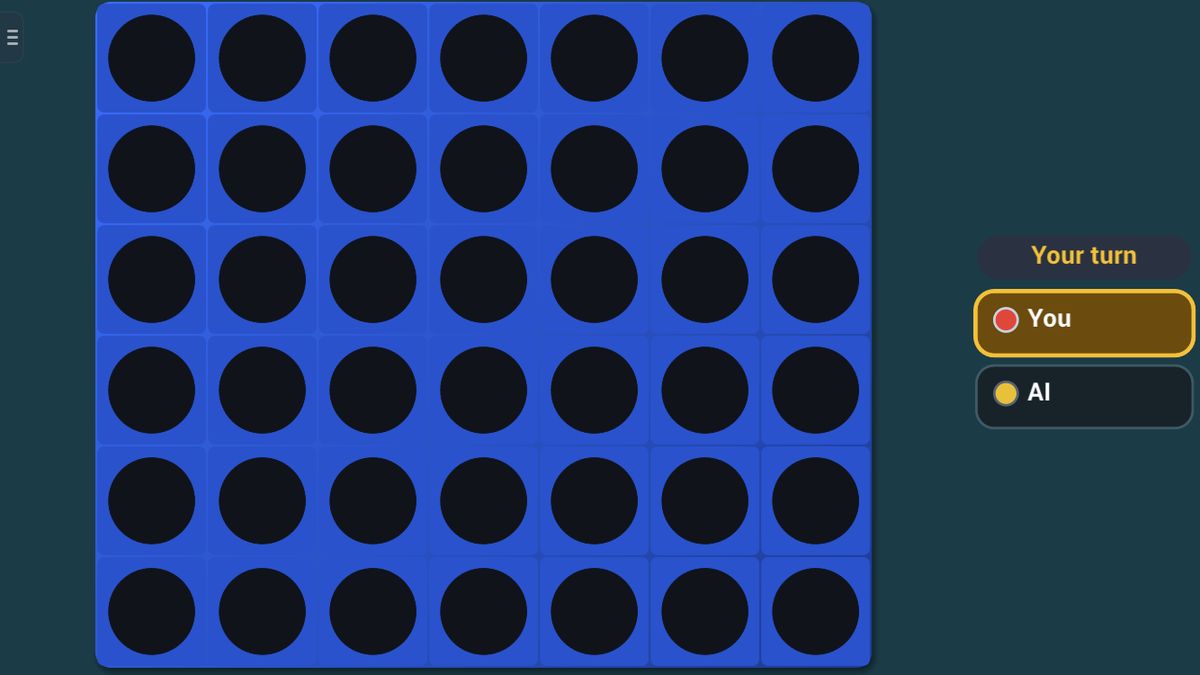
Take turns dropping a disc into a column; it falls to the lowest empty slot. The first to line up four of their discs in a row — horizontally, vertically, or diagonally — wins. A full board with no line is a draw.
The aim
The board stands upright, seven columns wide and six rows high. Red and Yellow take turns dropping discs into it. The first player to get four of their own discs in a straight line wins. The line can run across, straight up and down, or slanting from corner to corner.
How a turn works
Red always drops the first disc. Against the computer you choose who starts, so you may be Red or Yellow.
- Tap any column that still has room.
- Your disc falls to the lowest empty slot in that column. You never choose a slot higher up.
- That is your whole turn. Now the other player drops a disc.
A full column takes no more discs.
A small example. Red drops into the middle column. Yellow drops into the same column, and the yellow disc lands on top of the red one. Red then drops into the column just to the right, so two red discs sit side by side on the bottom row. Discs stack, so every drop changes what each column offers to both players.
Scoring and the end of the game
There are no points. The game ends the moment someone makes a line of four, and that player wins. The winning line lights up, so everyone can see how it happened.
If all 42 slots fill up and nobody has four in a line, the game is a draw.
Tips to play better
- Start in the middle. The centre column belongs to more possible lines than any other. The edge columns belong to the fewest.
- Build an open three. Three in a row along the bottom, with an empty slot you can reach at both ends, is very hard to stop. Your opponent blocks one end, and you finish at the other.
- Check all four directions before you drop. Slanting lines are the easiest to miss, for you and for your opponent.
- Block threes early. Three enemy discs with a free slot beside them means one drop wins. Stop it now, not next turn.
- Think about the slot above your disc. Your drop also makes the slot on top of it playable. Before you drop, check that it does not hand your opponent the fourth disc.
- Save a threat for later. A gap you need high up a column is a strong weapon. Make your opponent fill the slot below it.
Common mistakes
- Watching only across and up and down, then losing to a slanting line.
- Dropping a disc that lets the opponent land on top of it and complete four.
- Filling the edge columns early, where discs help very few lines.
- Blocking one end of an open three too late, when the other end is still free.
Playing with family
The rule takes ten seconds to explain, and even a young child sees at once when four discs line up. Grown-ups find plenty to think about in open threes and in slots that are not reachable yet.
In Jambolaya you can play against the computer. Choose Easy, Normal or Hard, choose who starts, and play a single game or a best of 3 or 5. Easy often makes careless drops, which suits a beginner. The guided lesson plays a short game with you. It shows why the centre matters and how discs stack. Then it lets you watch a loss to an unblocked column of three, and you finish with a win from your own open three.
In the app you can also play together nearby, each on your own phone or tablet, with no Wi-Fi or internet needed. The browser edition plays on one device.
Ways to play
- Against the computerPlay on one device against a computer opponent.
- Play together, nearbyOne-on-one with someone in the same room, each on your own phone or tablet. No Wi-Fi or internet needed. In the Jambolaya app.
- Learn by playingA guided lesson on the real game teaches you the rules one step at a time.
 Five-in-a-Row1–2 players
 Tic-Tac-Toe1–2 players
 Checkers1–2 players
 Chess1–2 players
 Dots & Boxes1–2 players
 Ship Battle1–2 players
 Backgammon1–2 players
 Mancala1–2 players