 Jambolaya
Liar's Dice
How to play
Everyone starts with five dice behind a cup and each round rolls them in secret — you see only your own. Play goes around with BIDS about the TOTAL number of a face showing across ALL players' dice: a bid names a quantity and a face, like "four 3s".
Ones (aces) are WILD and count as any face. Each new bid must be strictly higher than the last — a bigger quantity, or the same quantity with a higher face (you can never name a wild 1).
Instead of bidding you may call LIAR on the standing bid: every cup lifts and the real count of that face — wild 1s included — is compared to the bid.
If the count is LESS than the bid the bidder was bluffing and loses a die; otherwise the caller was wrong and loses a die. The loser leads the next round. Lose all your dice and you're out; the last player still holding dice wins.
Simplified: no "exact"/spot-on call and no single-die special rounds.
The aim
Liar's Dice is a bluffing game for 2 to 6 players. Everyone has five dice hidden under a cup, and you see only your own. Players take turns bidding on all the dice on the table, or calling LIAR when they think a bid is false. Whoever is wrong loses a die. Lose all your dice and you are out. The last player still holding dice wins.
How a turn works
Each round, everyone rolls in secret, then the bidding goes round the table.
A bid names a quantity and a face, like "four 3s". It means: "Among everyone's dice together there are at least four 3s." Ones are wild: a 1 counts as whatever face is bid, so you never bid on 1s.
On your turn, choose one:
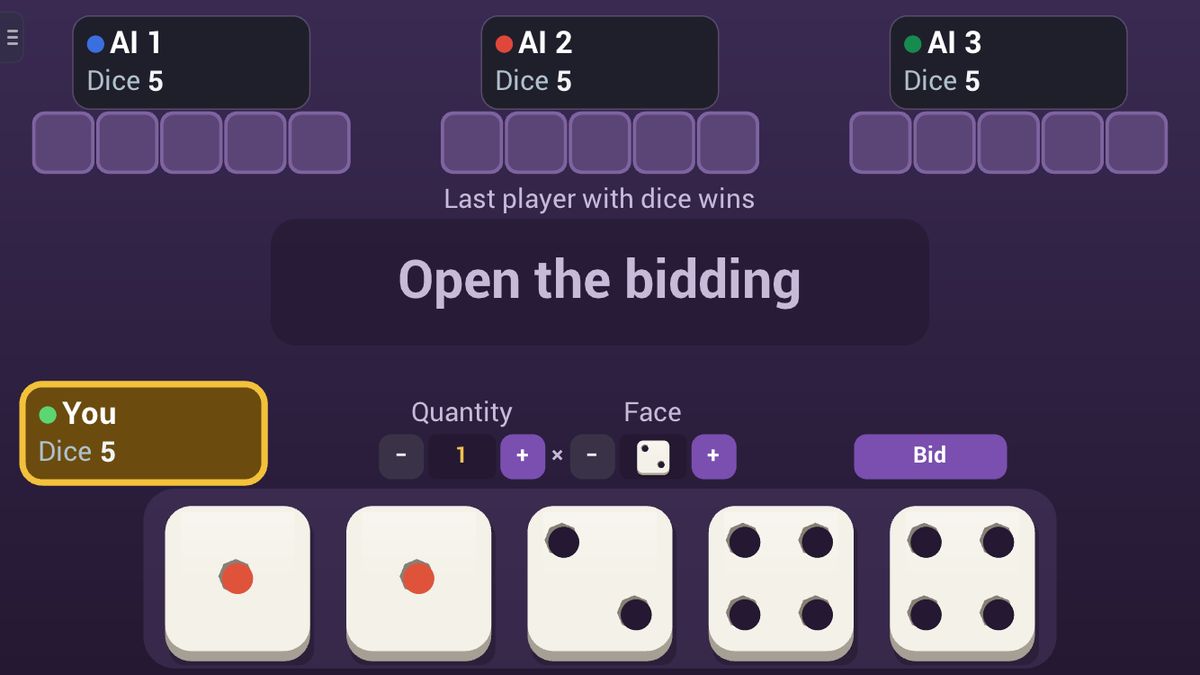
- Bid higher. Set the quantity and the face with − and +, then tap Bid. You must beat the last bid: more dice, or the same number on a higher face. After "four 3s" you may bid "four 5s" or "five 2s", but not "three 6s". No bid may ask for more dice than are on the table.
- Call LIAR. All the cups lift and the dice of the bid face are counted, wild 1s included.
The first player in a round has nothing to challenge and must bid.
A small example with two players. You hold 1, 3, 3, 4, 6: three 3s, thanks to the wild 1. You bid "three 3s". Your opponent raises to "four 4s". You hold one 4 and one wild, so two more 4s must hide in their five dice. Unlikely, so you call LIAR.
Scoring and the end of the game
When the dice are counted:
- Fewer than the bid said: the bidder was bluffing and loses a die.
- As many as the bid said, or more: the caller was wrong and loses a die.
Everyone rolls again, and the player who lost the die starts the next round, or the next player along if they are out. The last player with dice wins; there are no ties.
Jambolaya keeps it simple: there is no "exactly right" call and no special one-die rounds.
Tips to play better
- Count your own dice first. Your matching dice and 1s are certain.
- Expect about a third. Each hidden die shows the bid face or a wild 1 about one time in three. With ten dice in play, about three of a face is normal.
- Call when a bid climbs far above that. It is probably a bluff.
- Bid on your strong face. If you hold several 5s, bidding 5s is safer for you than for anyone else.
- Bluff now and then. If you only ever bid what you hold, the others learn to read you.
Common mistakes
- Forgetting the wild 1s, in your own cup and in everyone else's.
- Raising only because you are afraid to call, until you are the one caught.
- Thinking an exact count means the bidder lost. If the count matches the bid, the caller loses.
- Forgetting that late in the game, with few dice left, the same bid is much bolder.
Playing with family
Liar's Dice is full of laughter and brave faces, and suits a table of up to six. Children learn about chances without noticing.
In Jambolaya you can play against the computer: choose 2 to 6 players and Easy, Normal or Hard. Easy calls LIAR too soon and sometimes raises at random; Hard calls only clearly impossible bids. You open the bidding in the first round. The guided lesson shows wild 1s, your first bid, a call and the reveal, then a lost bluff and a winning call.
In the app you can also play together nearby, each on your own phone or tablet, with no Wi-Fi or internet needed. The browser edition plays on one device.
Ways to play
- Against the computerPlay on one device against a computer opponent.
- Play together, nearbyWith family and friends in the same room: up to 6 players, each on their own phone or tablet. No Wi-Fi or internet needed. In the Jambolaya app.
- Learn by playingA guided lesson on the real game teaches you the rules one step at a time.
 Dominoes1–4 players
 Reversi1–2 players
 Four-in-a-Row1–2 players
 Five-in-a-Row1–2 players
 Tic-Tac-Toe1–2 players
 Checkers1–2 players
 Chess1–2 players
 Dots & Boxes1–2 players