 Jambolaya

Fanorona
How to play
Slide a stone one step along a line to an empty point.
Capture by approach (move toward an enemy line — the stones directly beyond your landing point are taken) or by withdrawal (move away — the stones directly behind your start are taken); if a move offers both, you pick one.
Capturing is compulsory when any capture is available, and the same stone may keep capturing in new directions without revisiting a point. Diagonal lines exist only at the strong points. Capture every enemy stone to win.
The aim
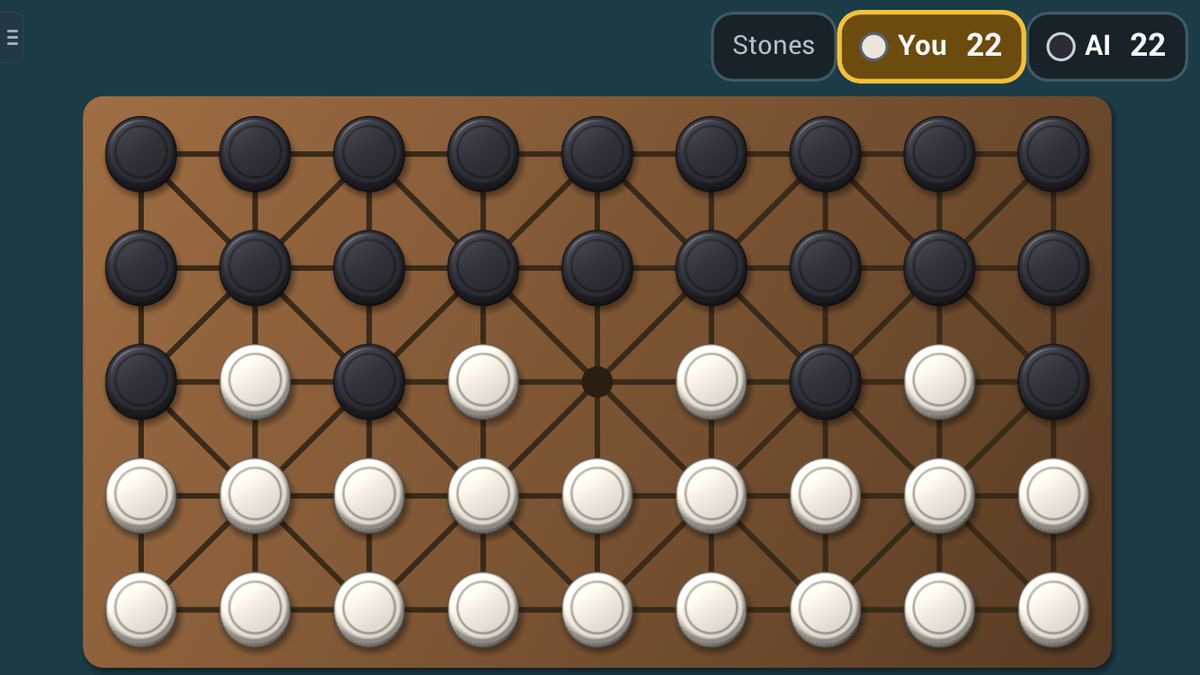
Fanorona is a two-player capturing game from Madagascar, White against Black. The board is a grid of points, nine across and five deep, joined by lines. Each side has 22 stones, and they fill every point except the one in the very centre. Capture every one of your opponent's stones to win.
How a turn works
White moves first. On your turn, slide one of your stones one step along a line to an empty point next to it. Every point has lines across and up and down, but only some have slanted lines. You may move on a slant only where one is drawn.
There are two ways to capture, and both use a single step.
- Approach. Step toward an enemy stone, so it sits right in front of you on the line you moved along. It is taken, with every enemy stone in an unbroken row behind it.
- Withdrawal. Step straight away from an enemy stone that was touching yours. It is taken, with the unbroken row behind it.
If one step could capture both ways, the app makes the capture that takes more stones.
Capturing is a must. If any capture is possible at the start of your turn, you have to make one. Only when there is no capture anywhere may you make a plain step.
Chains. After a capture, the same stone may capture again. It has to change direction each time, and it may not land on a point it has already visited this turn. Tap the stone itself to stop whenever you like.
A small example from the start: only the centre is empty. White slides the stone just below it into the centre. Two black stones stand in a row straight ahead, so both are captured at once.
Scoring and the end of the game
There are no points. You win when your opponent has no stones left. You also win if your opponent cannot make any move at all, which is rare.
If a game goes on for a very long time, the app ends it: the player with more stones left wins, and equal numbers make a draw.
Against the computer you can choose who starts, and play a single game or the best of three or five.
Tips to play better
- Always look both ways: check what an approach and a withdrawal would each take.
- Count the whole row. A single step can take four or five stones if they stand in a line.
- Plan your chains. A stone that can capture, turn, and capture again can take many stones in one turn.
- Look at what you leave behind. Captures are a must, so your opponent will take one of the captures you leave open, and it may start a long chain.
- Avoid a row of your stones with an empty point at its end. One approach into that point takes the whole row.
Common mistakes
- Forgetting withdrawal. Beginners look for stones to step toward and miss the ones they could take by stepping away.
- Stopping a chain too early when another capture was waiting.
- Making a capture that opens a straight line for a big capture by your opponent.
Playing with family
Fanorona is quick to start and full of surprises, because a single step can sweep away a whole row. Children love the big sweeps. The board lights up the points you can step to, and when you must capture, only capturing moves are offered.
In Jambolaya you can play against the computer on Easy, Normal or Hard. A guided lesson lets you make an approach, a withdrawal, and a chain with your own taps. In the app, two players can also play together nearby, each on their own phone or tablet, with no Wi-Fi or internet needed.
Ways to play
- Against the computerPlay on one device against a computer opponent.
- Play together, nearbyOne-on-one with someone in the same room, each on your own phone or tablet. No Wi-Fi or internet needed. In the Jambolaya app.
- Learn by playingA guided lesson on the real game teaches you the rules one step at a time.
 Pig1–4 players
 Farkle1–6 players
 Shut the Box1–4 players
 Liar's Dice1–6 players
 Dominoes1–4 players
 Reversi1–2 players
 Four-in-a-Row1–2 players
 Five-in-a-Row1–2 players