 Jambolaya
Tablut
How to play
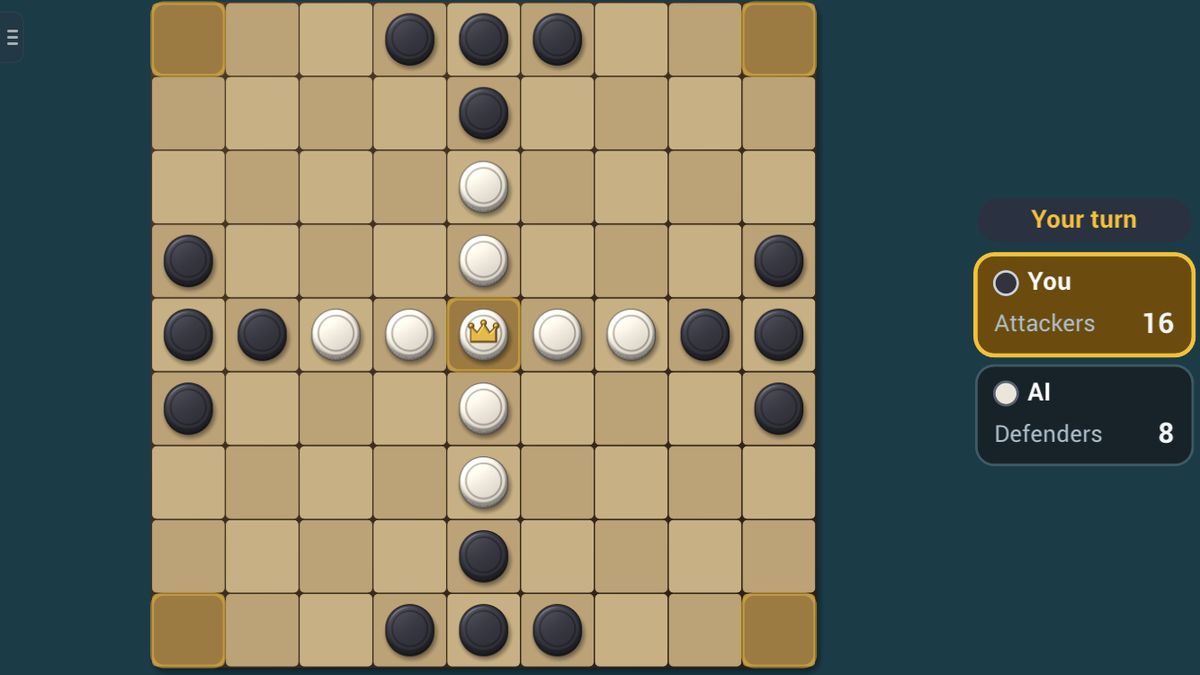
The 9×9 cousin of Brandub, the tafl game Linnaeus recorded among the Sámi. Sixteen attackers (they move first) ring a king and eight defenders on the central throne. Every piece moves like a chess rook — any distance in a straight line, without jumping.
The king's side wins by getting the king to any of the four corners; the attackers win by hemming the king in on all four sides (a board edge counts as a safe side, so trap it in the open — the empty throne or a corner can act as a wall).
Capture an ordinary enemy piece by sandwiching it between the piece you just moved and another of yours (or a corner / the empty throne) along a row or column — several can fall at once. Only the king may rest on the throne or a corner.
A player with no move loses.
The aim
Tablut is a siege on a 9 by 9 board. The king starts on the throne, the centre square, with eight defenders around him. Sixteen dark attackers wait on the four edges, four on each side. The king's side wins if the king reaches any of the four corners. The attackers win if they surround the king on all four sides.
How a turn works
The attackers always move first, then the sides take turns moving one piece.
- Tap one of your pieces, then one of the lit squares.
- Every piece, the king too, moves like a rook in chess: any distance along a row or column, over empty squares only. Nothing ever jumps.
- Only the king may stop on the throne or a corner. Other pieces may pass over the empty throne but never stop there, and never enter a corner.
Capturing. You take an ordinary enemy piece by trapping it between the piece you just moved and another of yours, in a straight row or column. A corner or the empty throne can stand in for your second piece. One move can capture in several directions at once, and the king can be either side of a trap.
Captures only happen when you make the trap, so you may safely move into a gap between two enemy pieces.
Example: a defender stands alone in the open, with an attacker on the square above it. You slide another attacker in from the side to the square below it. The defender is trapped between them and leaves the board.
Scoring and the end of the game
There are no points. The game ends as soon as one side reaches its goal.
- The king reaches a corner: the king's side wins.
- The king has an attacker on all four sides: the attackers win. The empty throne or a corner can count as one of those sides, but a board edge never does, so a king on the edge cannot be caught.
- A player who cannot move any piece loses.
- A very long game, 300 moves in all, ends in a draw.
Some versions of Tablut let the king escape to any edge square. Jambolaya plays the corner escape.
Tips to play better
- Attackers: guard the corners first. Put pieces near each corner so the king can never slide straight in.
- Attackers: close the lanes. Before every move, check each row and column the king can reach. One open line to a corner loses the game.
- King's side: make two threats. If the king can reach two corners next move, the attackers can only block one.
- King's side: move defenders out early. The king can't escape while his own pieces block his way.
- Look before you stop next to an enemy. If another enemy piece can slide onto the square behind you, you are about to be captured.
Common mistakes
- Chasing captures with the attackers while a lane to a corner stays open.
- Forgetting that the empty throne and the corners trap pieces too, for both sides.
- Trying to catch the king at the edge of the board, where he is safe.
Playing with family
There is only one way to move, which children pick up in a minute. The two sides play very differently, so swap between games and try both.
In Jambolaya you can play against the computer on Easy, Normal or Hard, a single game or a best of 3 or 5. Choosing to move first means you lead the attackers. In the guided lesson you lead the attackers through rook moves, a sandwich capture, the king's special rules, a loss and a win you finish yourself.
In the app, two players can also play together nearby, each on their own phone or tablet, with no Wi-Fi or internet needed. The browser edition plays on one device.
Ways to play
- Against the computerPlay on one device against a computer opponent.
- Play together, nearbyOne-on-one with someone in the same room, each on your own phone or tablet. No Wi-Fi or internet needed. In the Jambolaya app.
- Learn by playingA guided lesson on the real game teaches you the rules one step at a time.
 Triangles1–2 players
 Fanorona1–2 players
 Pig1–4 players
 Farkle1–6 players
 Shut the Box1–4 players
 Liar's Dice1–6 players
 Dominoes1–4 players
 Reversi1–2 players