 Jambolaya
Connect6
How to play
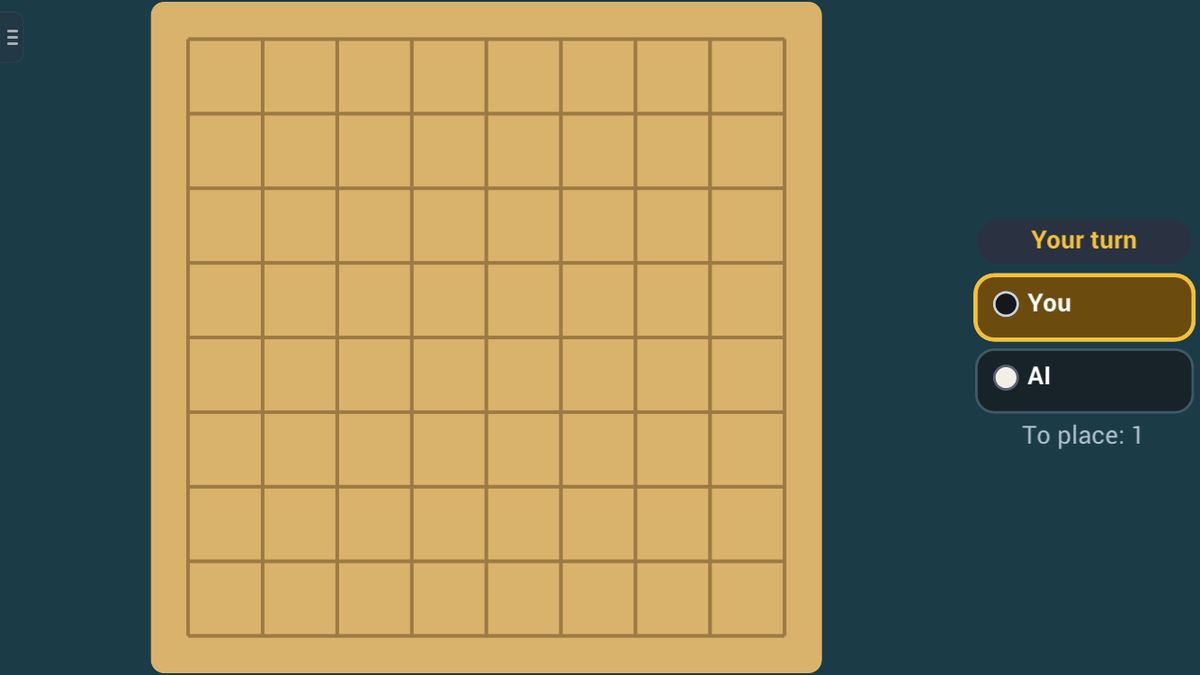
Stones sit on the line crossings. Black plays a single stone on the very first turn; after that each player places TWO stones per turn. The first to make an unbroken line of six or more of their own stones — horizontally, vertically, or diagonally — wins.
Placing two stones a turn means one move can build two threats at once, so watch both. A full board with no six is a draw.
The aim
Connect6 is a two-player game of black and white stones. Stones go on the crossings of the lines, not inside the squares. Be the first to make a line of six or more of your own stones in a row, across, up and down, or on a slant.
The twist is the number of stones. Black's very first turn is a single stone. After that, every turn, for both players, is two stones. That keeps the game fair, and fast.
How a turn works
- Black opens with one stone. The centre crossing is a good start.
- Then White places two stones, one tap at a time, on any empty crossings.
- From then on, each turn is a pair. The two stones can go anywhere: side by side, or far apart.
The last two stones played are marked, so after the other player's turn you can see both of their new stones at once. A small note shows how many stones you still have to place this turn.
A small example: you have two black stones in a row. Your pair arrives. Put one at each end. Now you have four in a row, and with only one more pair you could reach six. Now your opponent has to spend their turn blocking you.
Stones are never captured or moved.
Scoring and the end of the game
There are no points. The game ends the moment someone has six or more stones in an unbroken line, and that player wins. This is checked after every single stone, so the first stone of a pair can already win.
If the board fills up with no line of six, the game is a draw.
You choose the board size before you start: 9 by 9 crossings, or 13 by 13 for a longer game. (Connect6 is often played on a much bigger board.) Against the computer you can also choose who starts, and play a single game or the best of three or five.
Tips to play better
- Count in pairs. A line of four with room to grow is already a threat: one more pair makes six.
- Block early. When your opponent has four in a row, block it now. With open ends on both sides, it can take both of your stones.
- Use one stone to block and one to build.
- Make more threats than they can block. Your opponent has only two stones a turn, so three separate dangers cannot all be stopped.
- Gaps count. Four stones with one empty crossing in the middle can still become six in a single turn.
- Mind the edge. On a 9 by 9 board, a line needs room for six stones; one pointed at the edge may have no space to finish.
Common mistakes
- Thinking like a one-stone game and waiting for a line of five before blocking. By then, one stone often is not enough.
- Placing both stones on your own line while the other player quietly builds four of theirs.
- Forgetting slanted lines. Diagonals are easy to miss on a busy board.
Playing with family
The rule is easy to explain to a child: two stones, six in a row. Games are short, and there is nothing hidden and no luck. Grandparents who like quiet, thinking games will find plenty to plan.
In Jambolaya you can play against the computer on Easy, Normal or Hard. A guided lesson lets you place the opening stone, build with your pairs, and finish a line of six yourself. In the app, two players can also play together nearby, each on their own phone or tablet, with no Wi-Fi or internet needed; the host picks the board size.
Ways to play
- Against the computerPlay on one device against a computer opponent.
- Play together, nearbyOne-on-one with someone in the same room, each on your own phone or tablet. No Wi-Fi or internet needed. In the Jambolaya app.
- Learn by playingA guided lesson on the real game teaches you the rules one step at a time.
 Royal Game of Ur1–2 players
 Fox & Geese1–2 players
 Kōnane1–2 players
 Brandub1–2 players
 Tablut1–2 players
 Triangles1–2 players
 Fanorona1–2 players
 Pig1–4 players