 Jambolaya
Fox & Geese
How to play
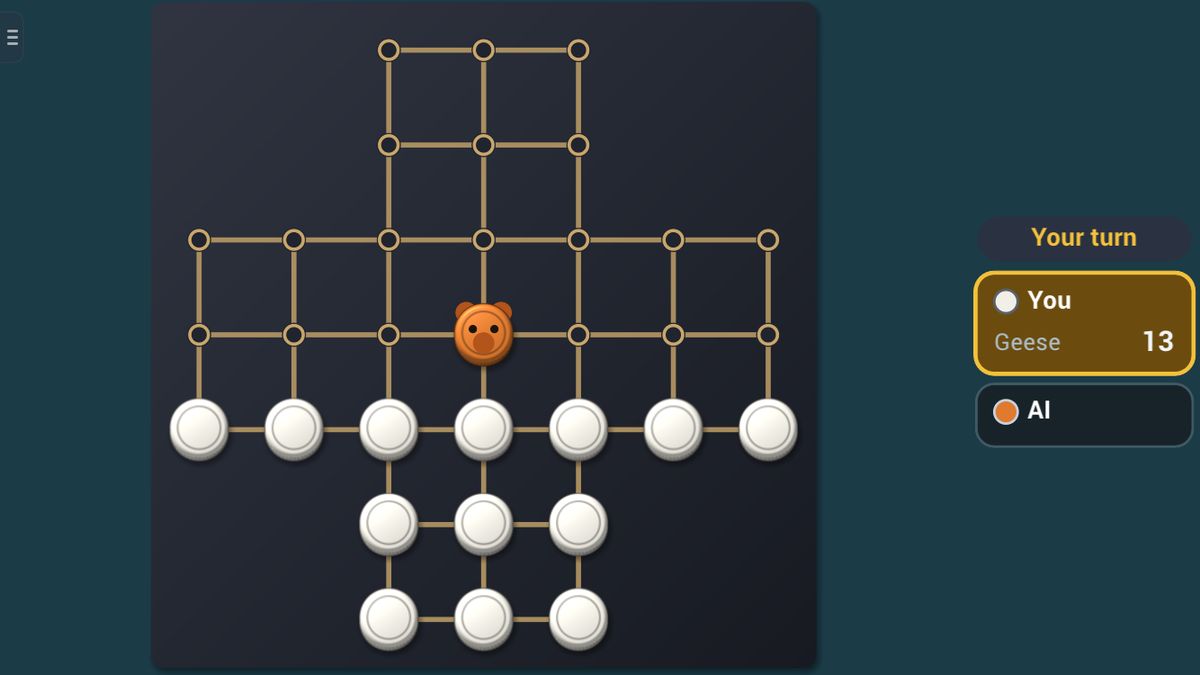
An asymmetric hunt on a cross-shaped board. One player commands the GEESE, the other the lone FOX. Geese move first: a goose steps one point along a board line onto an empty point and never captures.
The fox steps one point along any line, or jumps an adjacent goose to the empty point beyond to capture it (and may chain several jumps in one turn; tap the fox to stop).
The geese win by hemming the fox in so it cannot move; the fox wins by reducing the flock below six — too few to trap it. Variants (pick one in the setup): Standard — 13 geese, straight lines only, geese never move backward, jumping is optional.
The historical variants add the diagonal lattice and make the fox's first jump COMPULSORY: Classic (13 geese, geese move in every direction, even backward), 15 geese (geese use diagonals too but never move backward), and 17 geese in the French or English arrangement (geese move straight only, never backward).
The aim
This is a hunt for two players. One has 13 geese, the other a single fox, on a plus-shaped board of 33 points joined by lines. The geese win if they hem the fox in so it cannot move at all. The fox wins by eating geese until only five are left, because five geese are too few to trap it.
How a turn works
The geese start at the bottom of the cross: a full row of seven, plus the six points of the bottom arm. The fox starts on the centre point. The geese always move first.
- Geese: tap a goose, then a lit point. A goose steps one point along a line, forward or sideways, never backward. Geese never capture.
- Fox: steps one point along a line in any direction. Or it jumps: if a goose stands right next to it with an empty point straight behind, the fox leaps over and eats that goose.
- After a jump, the fox may jump again if another jump is open, eating goose after goose in one turn. Tap the fox to stop early.
A small example. A goose steps forward and lands beside the fox, with an empty point behind it. The fox jumps over it, and the goose is gone. With a goose on that point behind, the fox could not have jumped.
In the Standard rules the fox never has to jump.
Scoring and the end of the game
There are no points. The geese win the moment the fox has no move. The fox wins as soon as the flock drops to five. The fox also wins if the geese have no move left, or if the game reaches 300 moves, counting both sides. There are no draws.
Before the game you can pick other rule sets: Classic with 13 geese, 15 geese, or 17 geese in a French or English layout. These add slanting lines to the board, and the fox must jump when it can. Classic geese may even move backward; the others still cannot.
Tips to play better
- Keep the wall solid. A goose with an empty point behind it can be eaten. A goose with a friend behind it is safe.
- Advance slowly, together. Geese cannot go back, so a goose that runs ahead alone is stuck out there.
- Shrink the fox's space. Every safe step that takes away a point the fox could use brings the trap closer.
- As the fox, stay in the open. The arms of the cross are dead ends. Keep near the middle and wait for a goose with nothing behind it.
- As the fox, look for chains. Two or three geese with gaps behind them can go in one turn.
Common mistakes
- Stepping a goose right up to the fox with an empty point behind it.
- Racing ahead and leaving holes behind that geese can never go back to fill.
- Forgetting that the fox can jump sideways and backward, not only forward.
- As the fox, running into an arm of the cross where a few geese can close the door.
Playing with family
The two sides feel very different. A child often loves being the quick, hungry fox while a patient grandparent marches the geese. Then swap sides.
Against the computer, choose Easy, Normal or Hard. If you start, you play the geese; if the computer starts, you are the fox. You also pick the rule set and a single game or a best of 3 or 5. In the guided lesson you play the geese: you lose a goose, learn the solid wall, watch the fox win once, then close the trap yourself.
In the app you can also play together nearby, each on your own phone or tablet, with no Wi-Fi or internet needed. The browser edition plays on one device.
Ways to play
- Against the computerPlay on one device against a computer opponent.
- Play together, nearbyOne-on-one with someone in the same room, each on your own phone or tablet. No Wi-Fi or internet needed. In the Jambolaya app.
- Learn by playingA guided lesson on the real game teaches you the rules one step at a time.
 Kōnane1–2 players
 Brandub1–2 players
 Tablut1–2 players
 Triangles1–2 players
 Fanorona1–2 players
 Pig1–4 players
 Farkle1–6 players
 Shut the Box1–4 players