 Jambolaya
War
How to play
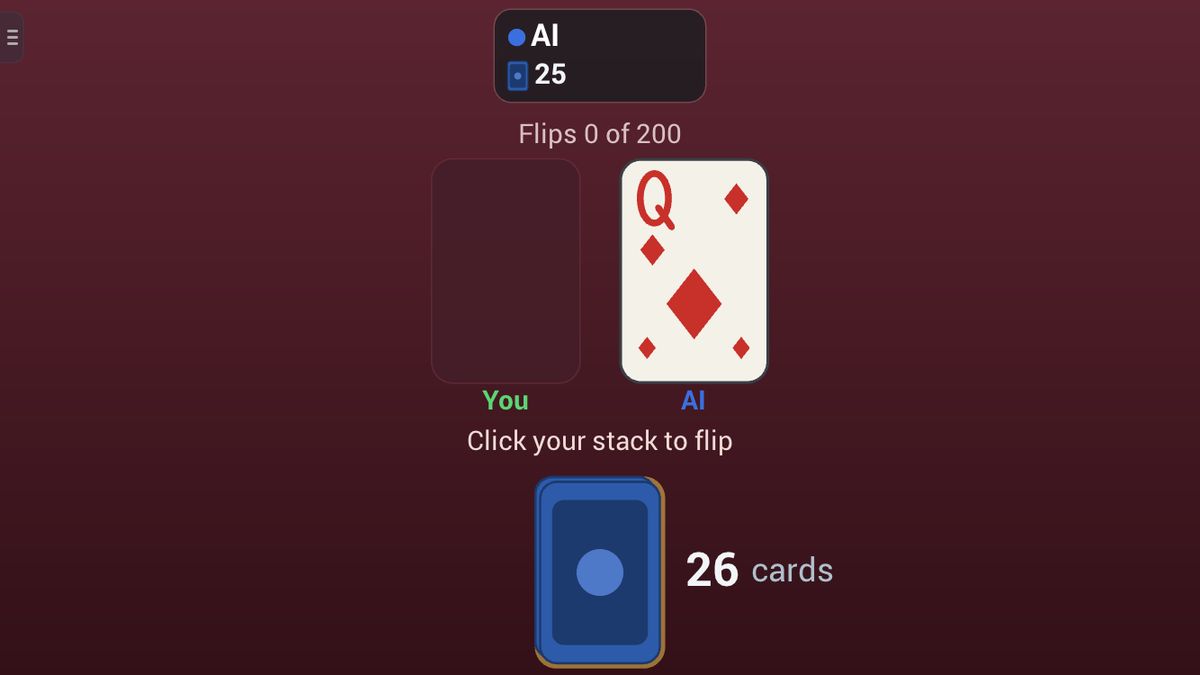
The deck is split face-down, 26 cards each. Every round both players flip their top card — tap your stack to flip; the round resolves once both cards are up.
The higher RANK takes both cards (suits don't matter, Ace high, 2 low), and captured cards go to the bottom of the winner's stack.
A tie means WAR: each player lays three cards face-down and flips one more face-up — the higher face-up takes everything on the table, and another tie repeats the war.
If you can't fund a war (fewer than four cards) you flip your last card as the face-up; if you have no cards left at all when a war starts, you lose on the spot.
You win by taking all 52 cards — or, since a full game can run very long, the bigger stack wins after 200 resolved flips (a mobile session cap).
The aim
War is a game of pure luck for two players. The whole deck is split between you, and you try to win every card. Nobody chooses anything: you turn cards over, and the higher card wins. That makes it a perfect first card game, and a good way to learn which card beats which.
How a turn works
The 52 cards are shuffled and dealt face down, 26 each. Your stack is at the bottom of the screen, your opponent's at the top, and the numbers show how many cards each of you holds.
- Flip. Tap your stack to turn its top card face up. Your opponent flips too. Nothing is decided until both cards are showing.
- Compare. The higher card takes both. Only the rank counts, never the suit. Ace is highest, then King, Queen, Jack, 10 and down to 2, the lowest.
- Collect. The winner's new cards go to the bottom of their stack, so they come back into play later.
A small example: you flip a 9 and Grandpa flips a 5. Your 9 wins, both cards go under your stack, and your count goes up by one.
War! When both cards have the same rank, say two 7s, it is war. Each of you lays three cards face down, then turns one more face up. The higher of the new face-up cards takes everything on the table: here, all ten cards. If those are equal too, the war happens again, and the pile grows even bigger.
If you have fewer than four cards when a war starts, you lay down what you can and turn your very last card face up. If you have no cards left at all when a war starts, you lose straight away.
Scoring and the end of the game
The only score is the number of cards in each stack. You win by taking all 52 cards.
A full game of War can go on for a very long time, so Jambolaya puts a limit on it. After 200 flips, the game stops and the player with the bigger stack wins. If both stacks are the same size, it is a draw. In the traditional game you simply keep going until one player has everything.
Tips to play better
War has no choices, so these tips are about enjoying it.
- Watch the counts during a war. A war can swing ten or more cards in one go, so even a small stack can come back.
- Notice where the aces are. An ace can never lose a battle, only tie with another ace. When you win one, it is a good sign for later.
- Use it to teach ranks. Ask a child to say which card is higher before the cards are compared. They learn that a Jack beats a 10 and an ace beats a King.
- Choose the pace. Against the computer, Easy makes it flip slowly and Hard makes it flip almost at once. Pick the speed that feels fun.
Common mistakes
- Thinking the suit matters. A 6 of hearts and a 6 of spades are equal, and that means war.
- Thinking you can play better. There is no clever move in War. A loss is just bad luck, not a mistake.
- Giving up too early. Stacks change hands quickly, especially after a war.
Playing with family
War is ideal for young children: no rules to forget, no reading, and every flip is exciting. Grandparents enjoy it as a gentle, chatty game.
In Jambolaya you can play against the computer at Easy, Normal or Hard. The level changes only how quickly the computer flips, never the rules. A guided lesson lets you flip, watch a battle and fight a war with your own taps. In the app, two people can also play together nearby, each on their own phone or tablet, with no Wi-Fi or internet needed.
Ways to play
- Against the computerPlay on one device against a computer opponent.
- Play together, nearbyOne-on-one with someone in the same room, each on your own phone or tablet. No Wi-Fi or internet needed. In the Jambolaya app.
- Learn by playingA guided lesson on the real game teaches you the rules one step at a time.
 Old Maid1–6 players
 Briscola1–4 players
 Cheat1–6 players
 Big Two1–4 players
 Golf1–4 players
 Durak1–5 players
 Cucumber1–6 players
 Scopa1–4 players