 Jambolaya
Big Two
How to play
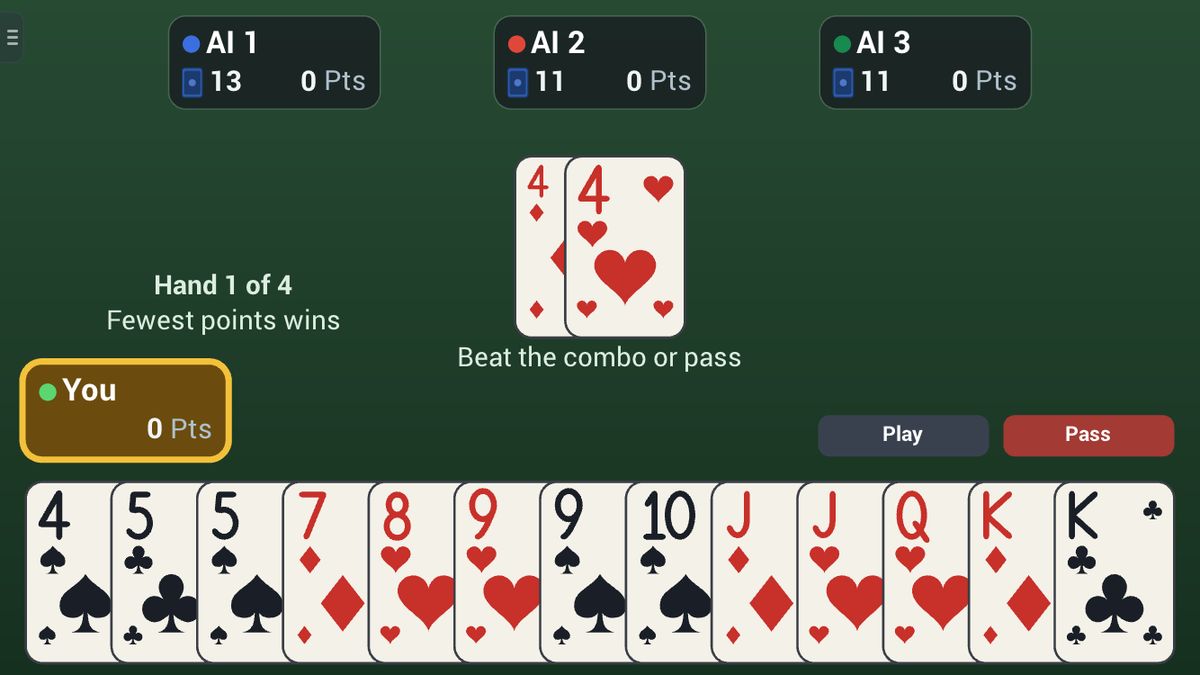
Every player is dealt 13 cards (three players get 17 with one card set aside; with two players each takes 13 from a shuffled deck and the rest sit out). Ranks climb 3, 4 … 10, J, Q, K, A, 2 — the 2 is the HIGHEST — and the suit order ♦ ♣ ♥ ♠ breaks rank ties.
Whoever holds the lowest dealt card (the 3♦ in a four-player game) leads first and must include it.
Play singles, pairs, triples, or five-card poker hands — straight, flush, full house, four-of-a-kind with a kicker, straight flush, each beating the ones before it. Straights run 3 up to A only: no 2s and no wraparound.
Beat the table with a HIGHER combo of the same size, or pass; when everyone else passes, the last player to play leads anything.
The first player to shed every card ends the hand and each rival takes penalty points equal to the cards left in their hand — doubled at ten or more. Four hands make a match; the LOWEST total penalty wins.
The aim
Big Two is a card game for two to four players. Everyone races to get rid of their cards. When one player plays their last card, the hand ends, and everyone else takes penalty points for the cards they still hold. A match is four hands, and the fewest penalty points wins.
How a turn works
With four players, each gets 13 cards. With three, each gets 17 and one card is set aside. With two, each gets 13 and the rest of the deck is not used.
The card order is unusual: 3 is lowest, then up through 10, Jack, Queen, King, Ace, and the 2 is highest. On the same rank the suit decides: diamonds, clubs, hearts, then spades highest. So the 3 of diamonds is the weakest card and the 2 of spades the strongest.
You may play a single card, a pair, or three of a kind. You may also play a five-card hand: a straight (five ranks in a row), a flush (five of one suit), a full house (three plus two), four of a kind with any fifth card, or a straight flush. Each beats the ones before it.
- In the first hand, whoever holds the lowest card dealt starts, and that card must be in the first play. With four players, it is the 3 of diamonds.
- The next player must play the same number of cards, and higher, or pass.
- Once you pass, you sit out until the pile is cleared.
- When everyone else has passed, the last player to play clears the pile and leads anything.
- In later hands, the previous hand's winner leads.
A small example. You lead the 3 of diamonds. The next player puts down the 7 of clubs. You hold the 7 of hearts: same rank, higher suit, so it wins. Then someone plays the 2 of spades. Nothing beats it, everyone passes, and that player leads next.
Scoring and the end of the game
The player who goes out scores nothing. Everyone else takes 1 point per card left in their hand, and holding 10 or more doubles it, so 10 cards cost 20 points.
After four hands, the lowest total wins. If players share the lowest total, they share the win.
Tips to play better
- Lead your low cards early. A lonely 4 is hard to get rid of later.
- Save your 2s. A 2 wins almost any single and gives you the lead back.
- Look for five-card hands. A straight or flush sheds five cards in one go.
- Watch the others' cards. If a rival has one card left, lead a pair or more, never a single.
- Don't break a good hand to beat one card. Splitting a pair or straight leaves loose cards nobody wants.
Common mistakes
- Thinking the Ace is highest. The 2 beats it.
- Trying to beat a pair with a single, or a single with a pair. The number of cards must match.
- Passing, then expecting to come back into the same pile.
- Building a straight with a 2, or wrapping from King through Ace to 2. Straights run from 3 up to Ace only.
Playing with family
Big Two suits children who know their cards and grandparents who enjoy a quick, lively game. A bad deal is soon forgotten.
In Jambolaya you can play against computer players on Easy, Normal or Hard, at a table of two, three or four. A guided lesson lets you lead the 3 of diamonds, beat a card by its suit and pass, then explains the penalty points and shows a lost and a won match.
In the app, two to four people can also play together nearby, each on their own phone or tablet, with no Wi-Fi or internet needed. The browser edition plays on one device.
Ways to play
- Against the computerPlay on one device against a computer opponent.
- Play together, nearbyWith family and friends in the same room: up to 4 players, each on their own phone or tablet. No Wi-Fi or internet needed. In the Jambolaya app.
- Learn by playingA guided lesson on the real game teaches you the rules one step at a time.
 Golf1–4 players
 Durak1–5 players
 Cucumber1–6 players
 Scopa1–4 players
 Sixty-Six1–2 players
 Rummy1–4 players
 Rummy 5001–7 players
 Manipulation Rummy1–5 players