 Jambolaya
Rummy
How to play
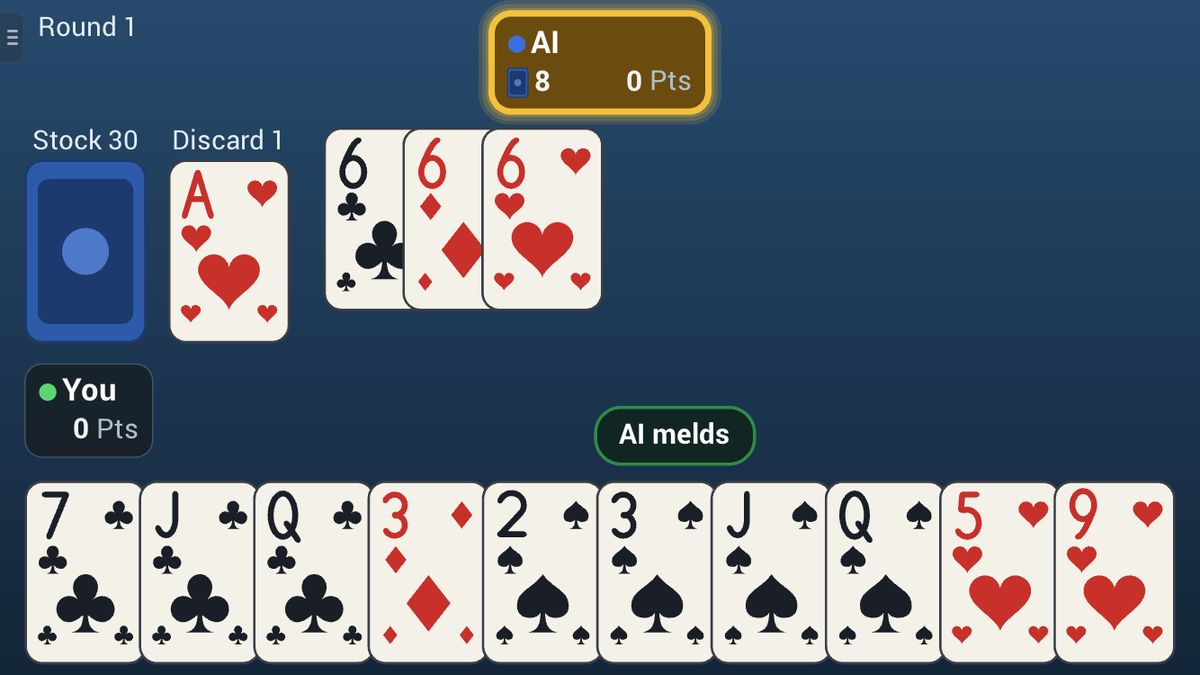
Draw and meld to empty your hand first. You're dealt ten cards (2 players) or seven (3–4).
Each turn: draw one card — the face-down stock or the top of the discard pile — then, if you like, lay down MELDS: a SET of 3–4 of the same rank, or a RUN of 3+ in one suit in sequence (Ace is low).
You may also lay cards off onto any meld already on the table, yours or an opponent's. Finish your turn by discarding one card — unless you just played your whole hand, which means you've gone out and the round ends.
Everyone else's leftover cards (Ace 1, faces 10, others face value) are added to your score. First to 100 points wins. The card you just took off the discard pile cannot go straight back the same turn, unless it is the only one left in your hand.
If the stock runs out, the discard pile, all but its top card, is shuffled into a new stock — at most twice a round; the third time, the round ends and the player holding the fewest points scores the difference (on a tie nobody scores).
The aim
In Rummy you get rid of your cards by laying them down in groups, called melds. The first player to empty their hand wins the round and scores the cards left in everyone else's hand. The first to reach 100 points wins the game.
How a turn works
Rummy is for 2 to 4 players with one 52-card deck and no jokers. With two players, each gets 10 cards; with three or four, 7. The rest is the face-down pile, and its top card is turned over to start the face-up pile.
On your turn:
- Draw one card from the top of the face-down pile or the face-up pile. You may not skip the draw.
- Meld, if you can. A set is 3 or 4 cards of the same rank, like three 8s. A run is 3 or more cards of one suit in order, like the 5, 6 and 7 of spades. The Ace is always low: A-2-3 is a run, Q-K-A is not.
- Lay off, if you can. Add a card to any meld on the table, yours or another player's.
- Discard one card onto the face-up pile. You can't throw back the card you just took from it, unless it is your last card.
A small example: you hold the 5 and 6 of spades, and the 7 of spades lies face up. Take it and meld 5-6-7. Your opponent has three Kings on the table and you hold the fourth, so lay it off on their Kings. Then throw away a card you don't need.
Scoring and the end of the game
You go out when your hand is empty, after melding or by discarding your last card. The round ends at once, and you score the cards left in every other hand: Ace 1, number cards their number, Jack, Queen and King 10. Nobody else scores that round.
If the face-down pile runs out, the face-up pile (all but its top card) is shuffled into a new one. This works twice a round. The third time, the round ends: the player with the lowest hand scores the difference between their hand and each other hand. If two tie for lowest, nobody scores.
The dealer moves on each round. The game ends when someone has 100 or more, and the highest total wins. If players are tied at the top, another round is played.
Tips to play better
- Lay melds down when you can. Cards on the table can no longer count against you.
- Throw away Kings, Queens, Jacks and 10s that fit nothing. Each costs 10 if someone else goes out.
- Watch what others take from the face-up pile, and don't throw them the cards they are collecting.
- Keep cards that work two ways, like a 7 of hearts next to a 7 of clubs and an 8 of hearts.
- Check the table for lay-offs every turn.
- Drag cards sideways in your hand to keep possible melds together.
Common mistakes
- Trying to meld Q-K-A. Here the Ace is low only.
- Forgetting you may lay off on other players' melds, not just your own.
- Saving melds to lay down all at once, then getting caught with them when someone goes out.
Playing with family
Rummy is a classic first card game. Children practise spotting matches and counting in order, and grandparents often know it already. Rounds are short, and a lucky draw can turn things around.
In Jambolaya you can play against the computer with 2 to 4 players, at Easy, Normal or Hard. A guided lesson lets you draw, meld, lay off and discard with your own taps, and shows the Ace-low rule and what happens when the face-down pile runs out. In the app, two to four people can also play together nearby, each on their own phone or tablet, with no Wi-Fi or internet needed.
Ways to play
- Against the computerPlay on one device against a computer opponent.
- Play together, nearbyWith family and friends in the same room: up to 4 players, each on their own phone or tablet. No Wi-Fi or internet needed. In the Jambolaya app.
- Learn by playingA guided lesson on the real game teaches you the rules one step at a time.
 Rummy 5001–7 players
 Manipulation Rummy1–5 players
 Palace1–4 players
 Slapjack1–4 players
 Spit1–2 players
 Spite & Malice1–2 players
 Gin Rummy1–2 players
 Crazy Eights1–6 players