 Jambolaya
Golf
How to play
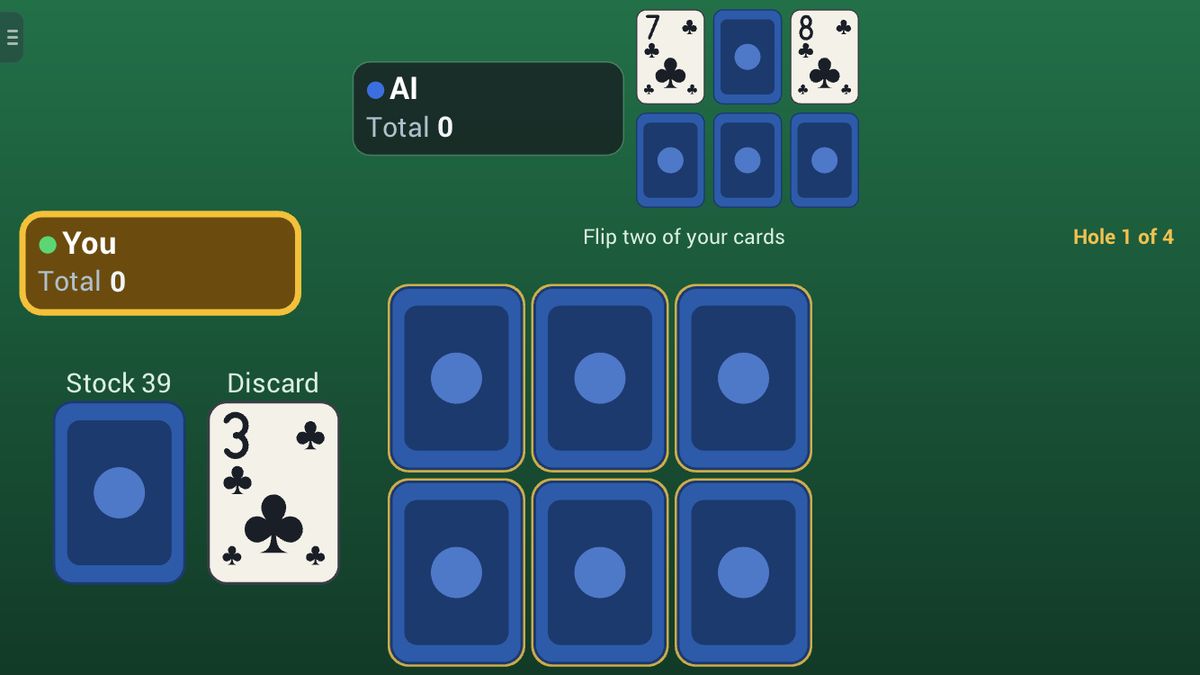
Two to four players each get six cards laid out face-down in a 2×3 grid; the rest is the stock and its top card starts the discard pile. To open the hole, everyone flips exactly two of their own cards — the rest stay secret, even from you.
On your turn, draw the top of the stock or the discard, then either swap it into your grid (the replaced card goes to the discard, the new one lands face-up) or — stock draws only — throw the draw away and flip one of your face-down cards instead.
A taken discard must be swapped in.
The moment any grid is fully face-up, every other player gets exactly one more turn, then everything is revealed and scored: A=1, 2=−2, 3–10 face value, J and Q=10, K=0 — and a COLUMN of two equal ranks cancels to 0 for both cards. Low is good.
The course here is a shortened four holes; the lowest total after hole 4 wins.
The aim
Golf is a card game for 2 to 4 players where, like real golf, low scores win. You swap and turn over your six cards to make them as cheap as possible. The best trick of all is a pair: two cards of the same rank, one above the other, cost nothing. A game is a short course of four rounds, called holes.
How a turn works
Everyone gets six cards face down in two rows of three. The rest of the deck is the face-down pile, and its top card is turned over to start the discard pile.
To begin the hole, every player turns over any two of their own cards. The other four stay hidden, even from you.
- Draw. Take the top card of the face-down pile, or the top card of the discard pile.
- Swap it in. Put the new card in place of any one of your six cards. The new card lies face up; the old one goes onto the discard pile.
- Or throw it away. If you drew from the face-down pile, you may put that card straight onto the discard pile instead. Then you must turn over one of your face-down cards. A card taken from the discard pile must always be swapped in.
Card values:
- King: 0
- Ace: 1
- Two: minus 2
- 3 to 10: their number
- Jack and Queen: 10
A small example: your top-left card is a face-up 5, and the discard pile shows another 5. Take it and put it right below your first 5. That column now scores 0.
If the face-down pile runs out, the discards are shuffled into a new one.
Scoring and the end of the game
The moment any player has all six cards face up, every other player gets exactly one more turn. Then all cards are turned over and counted. In each of the three columns, two cards of the same rank cancel to 0. Every other card scores its value.
Your score for each hole is added to your total. After the fourth hole, the lowest total wins. If players share the lowest total, the game is a draw.
Tips to play better
- Pairs are the heart of the game. A Queen paired with a Queen costs 0 instead of 20.
- Twos are the one card you should not pair. A single 2 is worth minus 2, but two 2s in a column only cancel to 0.
- Use your face-down slots for cheap cards. Putting a 3 into a hidden slot often swaps out something worse.
- Don't throw away a card that completes a rival's pair.
- Before you turn over your last card, add up your score. If you close out with a high total, the others get one more turn to beat you.
Common mistakes
- Taking a card from the discard pile with no plan. You must swap it in, even if nothing fits.
- Throwing away a card from the face-down pile and forgetting that you then have to turn one of your own cards over, which can end your grid early.
- Ignoring the columns. Two 6s side by side in the same row cost 12; one above the other they cost 0.
Playing with family
Golf is easy to explain and every turn is a small choice, so children stay involved. There is a bit of adding up at the end of each hole, which is good practice, and a lucky draw lets anyone win.
In Jambolaya you can play against one, two or three computer players, at Easy, Normal or Hard. A guided lesson lets you take a card, make a pair, throw a draw away and turn a card over with your own taps. In the app, two to four people can also play together nearby, each on their own phone or tablet, with no Wi-Fi or internet needed.
Ways to play
- Against the computerPlay on one device against a computer opponent.
- Play together, nearbyWith family and friends in the same room: up to 4 players, each on their own phone or tablet. No Wi-Fi or internet needed. In the Jambolaya app.
- Learn by playingA guided lesson on the real game teaches you the rules one step at a time.
 Durak1–5 players
 Cucumber1–6 players
 Scopa1–4 players
 Sixty-Six1–2 players
 Rummy1–4 players
 Rummy 5001–7 players
 Manipulation Rummy1–5 players
 Palace1–4 players