 Jambolaya
Scopa
How to play
An Italian fishing game with the 40-card deck (no 8s, 9s, 10s). Everyone gets three cards and four lie face-up on the table.
On your turn play a card: if it matches the value of a single table card you take that card; otherwise if some cards on the table ADD UP to your card's value you take that whole group; if neither, your card is left on the table.
Clear the last card off the table and you score a SCOPA (sweep) — a bonus point. When hands run out, three more are dealt, until the deck is gone (the last capturer takes what's left).
Then score a point each for: most cards, most coins, the seven of coins, and the best 'prime' — plus every sweep. First to 11 points wins.
The aim
Scopa is an Italian fishing game. You use the cards in your hand to catch cards lying face up on the table. You score for the cards you catch, and for sweeping the table bare. The first player to reach 11 points wins.
How a turn works
Scopa is for 2 to 4 players, each playing for themselves. It uses 40 cards: the 8s, 9s and 10s are taken out. Values: Ace 1, number cards 2 to 7 their number, Jack 8, Queen 9, King 10.
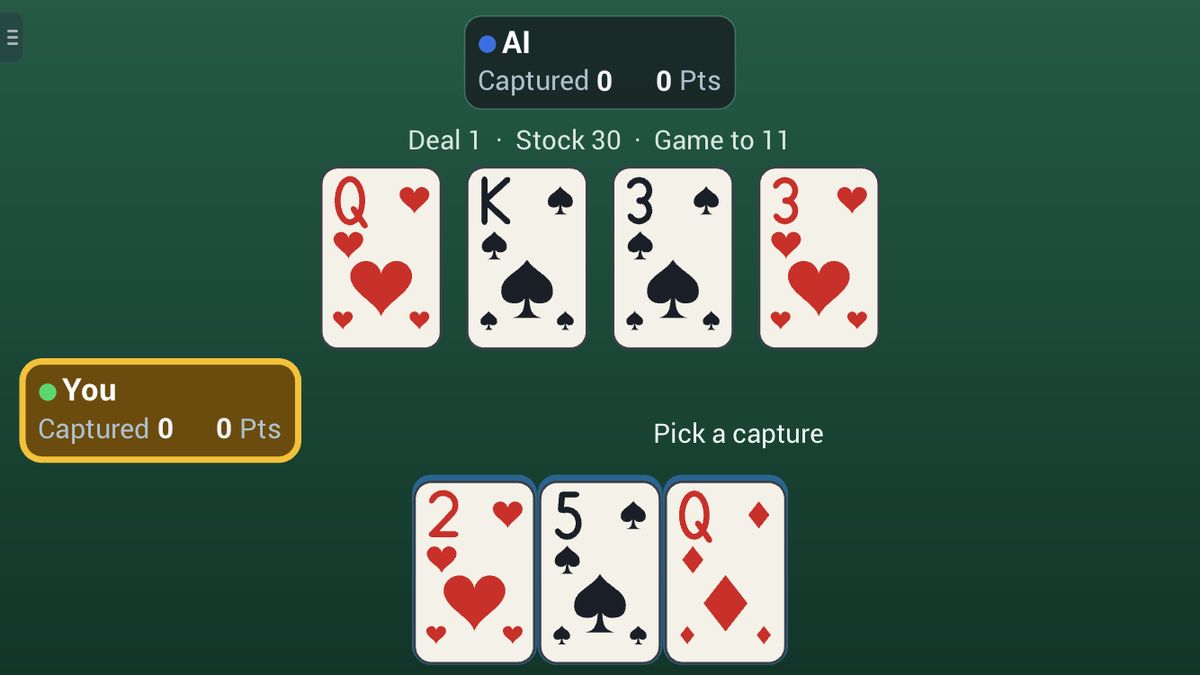
Everyone gets 3 cards, and 4 lie face up on the table. On your turn, play one card:
- Match one card. If a table card has the same value, you take it, along with the card you played.
- Or match a sum. If no single card matches but some table cards add up to your card's value, you take them all.
- Or leave it. If your card catches nothing, it stays on the table for anyone to catch later.
A single match comes first: with a 5 on the table, your 5 must take it, not a 2 and a 3. If your card can catch something, it does. Tap a card once to see what it will take, and again to play it.
A small example: the table shows a 3, a 4 and an Ace. No card is worth 8, but 3 + 4 + 1 = 8, so your Jack takes all three. If they were the only cards there, that is a scopa.
When every hand is empty, 3 more cards each are dealt, until the deck runs out. Cards left on the table at the end go to the last player who caught something.
Scoring and the end of the game
Clearing the table is a scopa, worth 1 point, except on the very last play of the deal. After each deal you also score 1 point for each of these:
- the most cards
- the most diamonds, which stand for the coins of the Italian deck
- the 7 of diamonds, the "sette bello"
- the best prime
For the prime, take your best caught card in each suit: a 7 is worth 21, a 6 18, an Ace 16, a 5 15, a 4 14, a 3 13, a 2 12, a picture card 10. The highest total wins the point. If players tie for cards, diamonds or the prime, nobody gets that point.
The game ends after a deal in which someone has 11 or more, and the highest total wins. If players are tied at the top, another deal is played.
Tips to play better
- Grab 7s when you can. They are worth the most for the prime, and the 7 of diamonds is a point by itself.
- Diamonds help twice: toward the most cards and the most diamonds.
- When you can't catch anything, don't leave a table that adds up to 10 or less. The next player may sweep it.
- Remember what has been played. If the other three 6s are gone, nobody can match your 6.
Common mistakes
- Trying to take a sum when a single card matches.
- Leaving the 7 of diamonds where the next player can catch it.
- Expecting a scopa point for clearing the table on the very last play.
Playing with family
Scopa is a lovely way for children to practise adding up to 10, and each turn is just one card.
In Jambolaya you can play against the computer with 2 to 4 players, at Easy, Normal or Hard. A guided lesson lets you catch a match, catch a sum and make a scopa with your own taps, then explains the scoring. In the app, two to four people can also play together nearby, each on their own phone or tablet, with no Wi-Fi or internet needed.
Ways to play
- Against the computerPlay on one device against a computer opponent.
- Play together, nearbyWith family and friends in the same room: up to 4 players, each on their own phone or tablet. No Wi-Fi or internet needed. In the Jambolaya app.
- Learn by playingA guided lesson on the real game teaches you the rules one step at a time.
 Sixty-Six1–2 players
 Rummy1–4 players
 Rummy 5001–7 players
 Manipulation Rummy1–5 players
 Palace1–4 players
 Slapjack1–4 players
 Spit1–2 players
 Spite & Malice1–2 players