 Jambolaya
Cascade
How to play
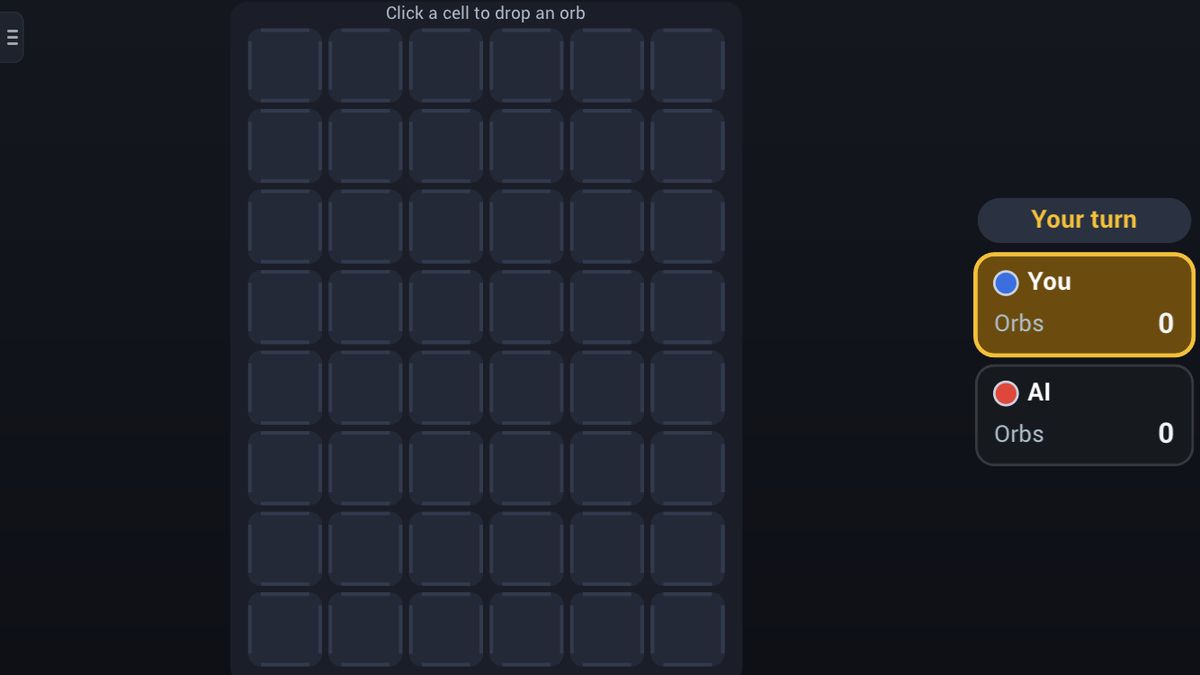
On your turn drop one orb into any cell that is empty or already yours.
When a cell holds as many orbs as it has touching cells (two in a corner, three on an edge, four inside) it bursts: it sends one orb into each neighbour and turns them all your colour — which can set off a chain reaction.
Capture every rival's orbs to take over the grid and win.
The aim
Cascade is a game of orbs and chain reactions for 2, 3 or 4 players. Each player has a colour: blue, red, green or yellow. The board is a grid of 48 cells, six by eight. You add orbs to cells until they burst, and every burst grabs the cells next to it. The aim is to turn every orb on the board into your colour. When only your colour is left, you win.
How a turn works
The players take turns, and blue goes first.
- On your turn, tap one cell to add one orb of your colour.
- You may choose an empty cell, or a cell that is already yours. You may never add to another player's cell.
- That is the whole turn, unless your cell bursts.
A cell bursts when it holds as many orbs as it has neighbours, meaning the cells touching its sides. A corner cell has 2 neighbours, so it bursts with 2 orbs. An edge cell has 3, so it bursts with 3. A cell in the middle has 4, so it bursts with 4.
When a cell bursts, it empties and sends one orb into each neighbour. Every neighbour it lands in turns your colour, even if it belonged to someone else, and keeps all its orbs. If a neighbour now has enough orbs, it bursts too. This is the chain reaction, and it can sweep across the board in one turn.
Example: you have one orb in the top-left corner. You add a second. The corner bursts, and the two cells beside it each get one of your orbs. Next turn, one of those edge cells may be ready to burst into your opponent's orbs.
Scoring and the end of the game
There are no points. The number beside each player shows how many orbs they own, which tells you who is ahead.
A player who has lost every orb is out, and their turns are skipped. Nobody can be knocked out before they have had a first turn. The game ends when only one colour is left on the board, and that player wins. There are no draws.
Tips to play better
- Corners are strong. They need only two orbs to burst, so they fire fast.
- Count before you add. A cell one orb away from bursting is a loaded cell. Look for your opponent's loaded cells next to yours.
- Don't put a fresh orb beside an enemy cell that is about to burst. It will simply be taken.
- If your loaded cell sits next to an enemy loaded cell, burst first. Whoever bursts first takes both.
- Line up loaded cells next to each other. One burst can then set off the whole row.
- With three or four players, let the others fight each other while you build quietly in a corner.
Common mistakes
- Spreading single orbs everywhere. They are easy to capture and do little.
- Forgetting that a capture keeps the orbs. A captured cell full of orbs may be ready to burst for its new owner.
- Thinking you are safe because you have many orbs. One long chain can take them all in a single turn.
Playing with family
Cascade is loud, colourful and fast. Children love watching a chain race across the board, and the counting is simple: 2, 3 or 4. Luck plays no part, but big swings mean nobody is out of it until the very end.
In Jambolaya you can play against one, two or three computer players at Easy, Normal or Hard, or choose Pass & Play to share one screen with 2 to 4 friends. The guided lesson has you burst a corner, capture a red orb and finish with your own winning chain. In the app, 2 to 4 people can also play together nearby, each on their own phone or tablet, with no Wi-Fi or internet needed.
Ways to play
- Against the computerPlay on one device against a computer opponent.
- Play together, nearbyWith family and friends in the same room: up to 4 players, each on their own phone or tablet. No Wi-Fi or internet needed. In the Jambolaya app.
- Learn by playingA guided lesson on the real game teaches you the rules one step at a time.
 Breakthrough1–2 players
 Lines of Action1–2 players
 Order & Chaos1–2 players
 Connect61–2 players
 Royal Game of Ur1–2 players
 Fox & Geese1–2 players
 Kōnane1–2 players
 Brandub1–2 players