 Jambolaya

Odd One Out
How to play
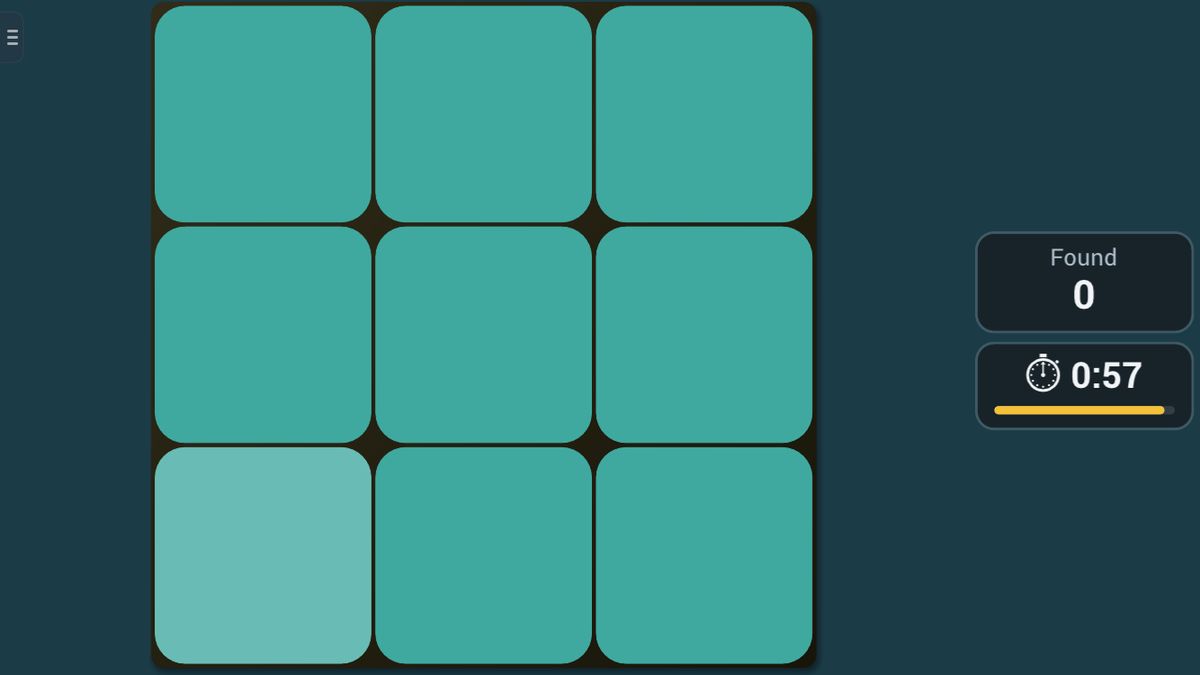
Every tile is the same colour except one, which is a slightly different shade. Tap the odd tile. Each hit makes the grid a little bigger and the difference a little subtler; a miss eases it back. Find as many as you can before time runs out.
The aim
In Odd One Out, every tile in a grid looks the same colour, except one. That tile is a slightly lighter shade. Find it and tap it, and a new grid appears, a little harder. Your aim is to find as many odd tiles as you can before the clock runs out.
How to play
There are no turns. You play at your own speed until time is up.
- Look at the grid. One tile is just a little lighter than the rest.
- Tap the tile you think is different.
- Right or wrong, the real odd tile gets a white ring for a moment. If you were wrong, your tile gets a red ring.
- A new grid appears, often in a new colour.
Each find makes the difference between the shades a little smaller. After every third find, the grid also grows by one row and one column. A wrong tap scores nothing, and the grid shrinks back one size, which gives you a breather.
An example on Normal: on a 3×3 grid of blue tiles, the middle one is clearly paler. Found! After three finds the grid becomes 4×4. You tap a corner tile, but the white ring shows the odd one was two tiles away. No point, and the next grid is 3×3 again.
Before you start, choose the Difficulty:
- Easy: grids from 3×3 to 4×4, and the difference stays fairly easy to see.
- Normal: grids from 3×3 to 6×6, and the difference can become very faint.
- Hard: grids from 4×4 to 7×7, with a difference that starts smaller and ends fainter still.
Scoring and the end of the round
Each odd tile you find is one point, shown as Found. A wrong tap never takes points away; it only costs time.
Alone, you choose a round of 1, 3 or 5 minutes. In a race, the round lasts 60 seconds, everyone starts from the same grids, and the player who invites picks the level. You see each rival's score, but never their grid.
When the clock runs out, the highest score wins. If two players have the same score, it is a draw. With three or more players, everyone who shares the top score draws, and the others lose.
Tips to play better
- Look row by row. Sweep across the top row, then the next, so you never check a tile twice.
- Look for the lighter one. The odd tile is always lighter, never darker and never a different colour.
- Soften your gaze. On a big grid, take in the whole grid for a second without fixing on one tile. The odd one often seems to glow.
- Hold the screen straight. Tilting it, or a glare on it, can make some tiles look lighter than others.
Common mistakes
- Tapping the first tile that seems odd. Edges and corners can trick your eyes. Check it against its neighbours.
- Staring at one spot. Looking hard at a single tile makes all the shades look alike. Keep your eyes moving.
- Guessing to save time. Guesses cost no points, but they shrink the grid and use up seconds that could have been a find.
Playing with family
Odd One Out needs no reading, no numbers and no fast fingers, just a careful eye, so young children and grandparents can play side by side. Easy keeps the grid small and the shades clear.
The guided lesson plays a real round. You find the odd tile three times, the shades get closer each time, and on the third find you watch the grid grow.
There is no computer opponent. Play alone, or, in the app, race with two to six players together nearby, each on their own phone or tablet, with no Wi-Fi or internet needed. The browser edition plays on a single device.
Ways to play
- On your ownPlay alone, whenever you like.
- Play together, nearbyWith family and friends in the same room: up to 6 players, each on their own phone or tablet. No Wi-Fi or internet needed. In the Jambolaya app.
- Learn by playingA guided lesson on the real game teaches you the rules one step at a time.
 Quick Tap1–2 players
 Perfect Ten1–2 players
 Echo Chain1–2 players
 What Changed?1–2 players
 Color Clash1–2 players
 Shopping List1–2 players
 Math Sprint1–2 players
 Number Recall1–2 players