 Jambolaya
Perfect Ten
How to play
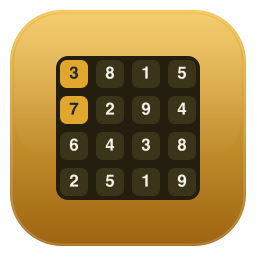
Tap two neighbouring tiles whose numbers add up to 10 to clear the pair — they refill with new digits, so it never runs out. Soothing and endless; your score is the number of pairs you make before time runs out.
The aim
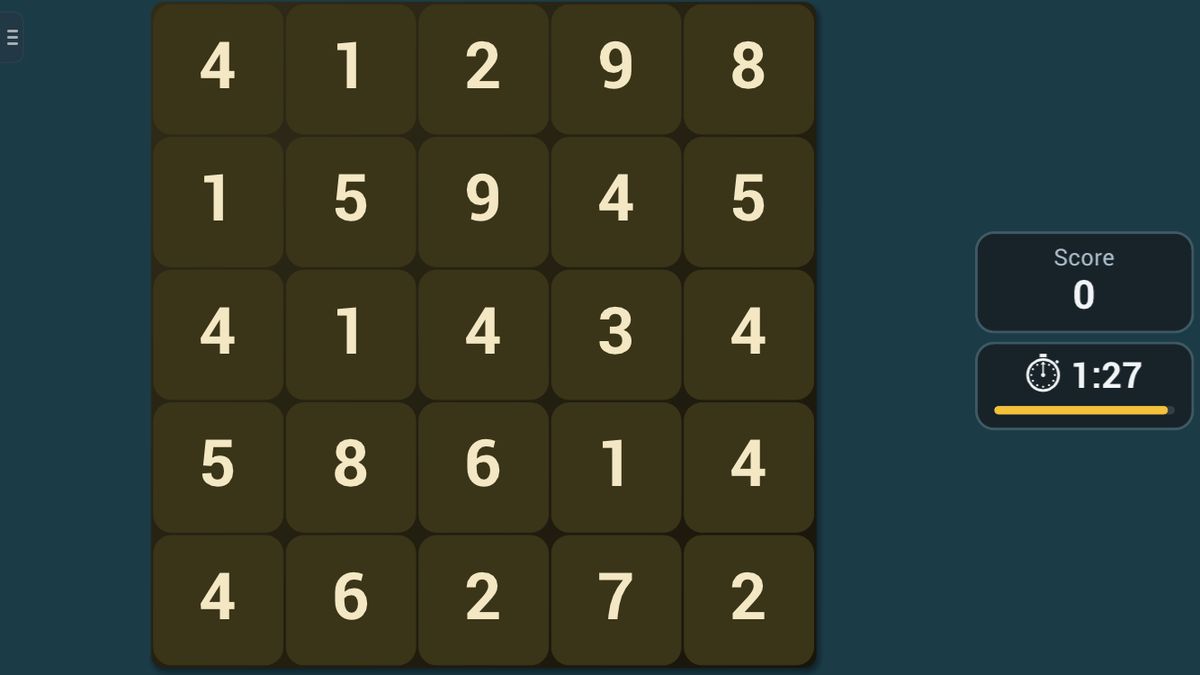
In Perfect Ten, a grid is full of numbers from 1 to 9. Find two numbers side by side that add up to 10, and tap both. They light up green and get new numbers, so the grid never runs out. Your aim is to make as many tens as you can before the clock runs out.
How to play
There are no turns. You play at your own speed until time is up.
- Tap a number. A gold ring shows it is chosen.
- Tap a number touching it above, below, left or right. Diagonals do not count.
- If the two add up to 10, they glow green for a moment, then both squares get new numbers.
- If they do not, nothing bad happens. The second number simply becomes your new choice.
- Tap a chosen number again to let go of it.
The pairs that make 10 are 1 and 9, 2 and 8, 3 and 7, 4 and 6, and 5 and 5.
An example: the top row shows 3, 6, 4. You tap the 6, then the 4 beside it. Ten! Both squares glow green and get new numbers, maybe a 7 and a 2. Now look at the new 7: is there a 3 touching it?
Before you start, choose the Difficulty:
- Easy: a 4×4 grid that always holds at least four pairs, so a ten is never hard to find.
- Normal: a 5×5 grid with at least one pair. If no pair is left after a refill, the whole grid is mixed again.
- Hard: a 6×6 grid with only one or two pairs at a time, hidden among 36 numbers.
Scoring and the end of the round
Each pair you clear is one point. Wrong taps cost nothing but a moment.
Alone, you choose a round of 1, 3 or 5 minutes. In a race, the round lasts 90 seconds, both players start with exactly the same grid, and the player who invites picks the level. You see your rival's score, but never their grid. When the clock runs out, the higher score wins. Equal scores are a draw.
Tips to play better
- Know your pairs by heart. When 9 and 1, 8 and 2, 7 and 3, 6 and 4, 5 and 5 come without thinking, you only have to look.
- Check one number at a time. Spot a 9, then look only at its four neighbours for a 1. That is faster than searching everywhere at once.
- Start from the big numbers. A 9 can only pair with a 1, and an 8 only with a 2, so they are quick to check.
- Watch the new squares. Fresh numbers often make a pair with a neighbour, so look there first after each ten.
- On Hard, sweep row by row. With only one or two pairs on the grid, a steady scan beats darting around.
Common mistakes
- Choosing diagonal pairs. A 4 and a 6 that only touch at a corner do not count.
- Forgetting 5 and 5. Two fives side by side make a perfectly good ten.
- Worrying about a wrong pair. There is no penalty. The second number is simply chosen instead, so keep going.
Playing with family
Perfect Ten is calm and friendly, and a lovely way for children to practise the pairs that make 10. Grown-ups and grandparents can enjoy it as a relaxing puzzle. Easy, with plenty of pairs, suits younger players.
The guided lesson plays a real grid. The coach rings numbers that have a partner, you make your first ten, then it shows how the squares refill.
There is no computer opponent. Play alone, or, in the app, race one other player together nearby, each on your own phone or tablet, with no Wi-Fi or internet needed. The browser edition plays on a single device.
Ways to play
- On your ownPlay alone, whenever you like.
- Play together, nearbyOne-on-one with someone in the same room, each on your own phone or tablet. No Wi-Fi or internet needed. In the Jambolaya app.
- Learn by playingA guided lesson on the real game teaches you the rules one step at a time.
 Echo Chain1–2 players
 What Changed?1–2 players
 Color Clash1–2 players
 Shopping List1–2 players
 Math Sprint1–2 players
 Number Recall1–2 players
 Number Forge1–2 players
 Anagram Twist1–2 players