 Jambolaya
More or Less
How to play
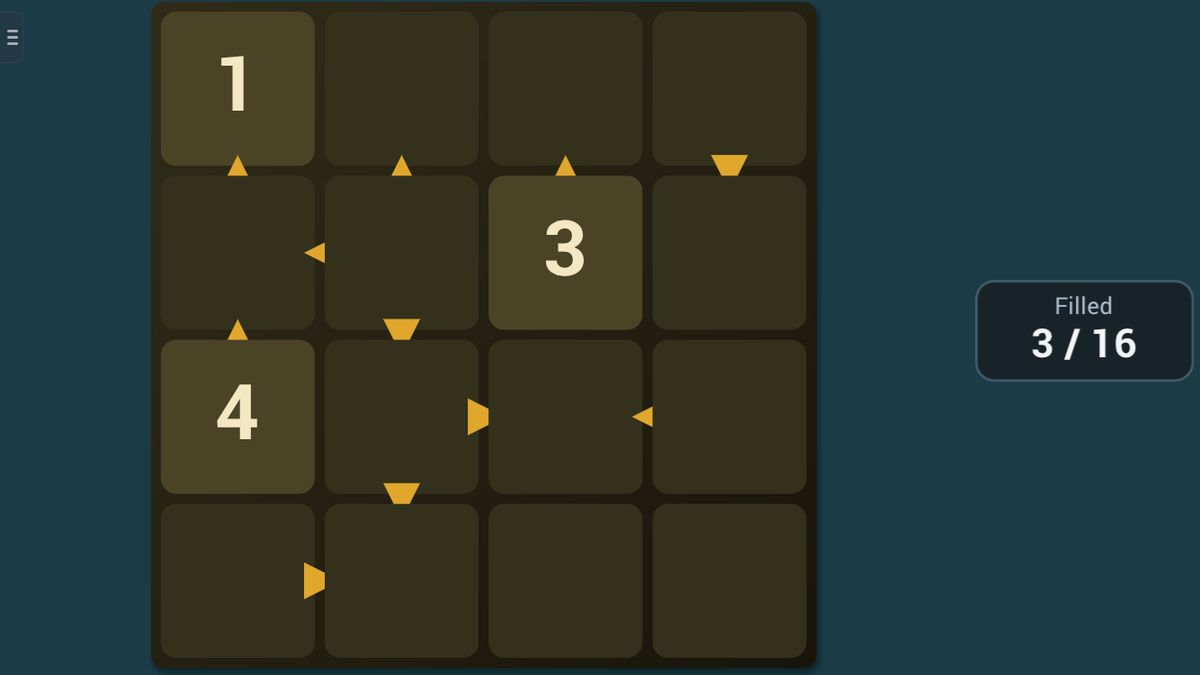
Fill the grid so every row and column contains 1 to 4 with no repeats, and every < or > arrow between two cells points from the larger number to the smaller. Tap a cell to cycle its value. A few given cells are fixed. Complete a valid grid to finish.
The aim
More or Less is a small number grid with a twist. Fill every square so each row and each column holds every number once, with no repeats. Between some neighbouring squares sits a little gold arrow, and every arrow must be true: its tip points at the smaller of the two numbers.
How to play
There are no turns. First choose a level:
- Easy: a 3×3 grid, numbers 1 to 3.
- Normal: a 4×4 grid, numbers 1 to 4.
- Hard: a 5×5 grid, numbers 1 to 5.
A few squares are already filled in. They have a lighter tint and are locked, so you cannot change them. To fill an empty square, tap it. Each tap moves it one step: 1, 2, 3, and so on up to the biggest number, then blank again. Beside the grid, the app shows how many squares are filled. It does not warn you about mistakes as you go.
An example on Normal: an empty square sits next to a locked 2, and the arrow between them points at the empty square. So the empty square is smaller than 2, which means it must be 1. Tap it once and you are done with it.
Scoring and the end of the game
There are no points. The game ends the moment every square is filled and every row, column and arrow is correct. Any grid that keeps all the rules counts. If the grid is full but nothing happens, something is still wrong.
Alone, there is no clock. When you finish, the app tells you how many seconds you took.
In a race, both players get exactly the same grid, and the player who invites picks the level. You can see how far your rival has got, as a percentage, but never their numbers. The first to complete a correct grid wins, and the race ends for both. If you finish moments apart, the faster time wins; exactly the same time is a draw.
Tips to play better
- An arrow tip rules out the top number. A square an arrow points at is smaller than its neighbour, so it can never be the biggest number. A square an arrow points away from can never be 1.
- Follow chains of arrows. If three squares in a line each point at the next, then on Normal the first one must be 3 or 4 and the last must be 1 or 2.
- Finish nearly full rows first. When a row or column has only one gap, the missing number is the only one that can go there.
- Count your taps. Tapping goes round in a circle. To change a 3 into a 1 on Normal, tap three times: 4, blank, then 1.
- Fill only what you are sure of. A guess that looks fine now can block the whole grid later.
Common mistakes
- Reading the arrow backwards. The pointed tip always points at the smaller number; the wide side faces the bigger one.
- Checking rows but forgetting columns. A number can fit its row perfectly and still repeat in its column.
- Missing an arrow. The small arrows sit in the gaps. Scan the gaps, not just the squares.
Playing with family
More or Less needs no reading, only the ideas of "bigger" and "smaller". Easy, with just nine squares and the numbers 1 to 3, is a friendly first puzzle for children. Hard, with 25 squares, challenges grown-ups.
The guided lesson rings a real arrow, shows the locked squares, and lets you tap a square up to the right number while it explains the arrow next to it.
There is no computer opponent. Play alone at your own pace, or, in the app, race one other player together nearby, each on your own phone or tablet, with no Wi-Fi or internet needed. The browser edition is for one device.
Ways to play
- On your ownPlay alone, whenever you like.
- Play together, nearbyOne-on-one with someone in the same room, each on your own phone or tablet. No Wi-Fi or internet needed. In the Jambolaya app.
- Learn by playingA guided lesson on the real game teaches you the rules one step at a time.
 Trail Trace1–2 players
 Pair Up1–4 players
 Match Dash1–2 players
 Pattern Flash1–2 players
 Number Hunt1–2 players
 Alphabet Run1–2 players
 Mirror Mates1–2 players
 Letter Trace1–2 players