 Jambolaya
Minesweeper Duel
How to play
Reveal cells without hitting a mine. Each revealed number tells how many mines touch that cell; use the numbers to deduce safe cells and flag the rest. Clear the whole board first to win — hit a mine and you're out.
The aim
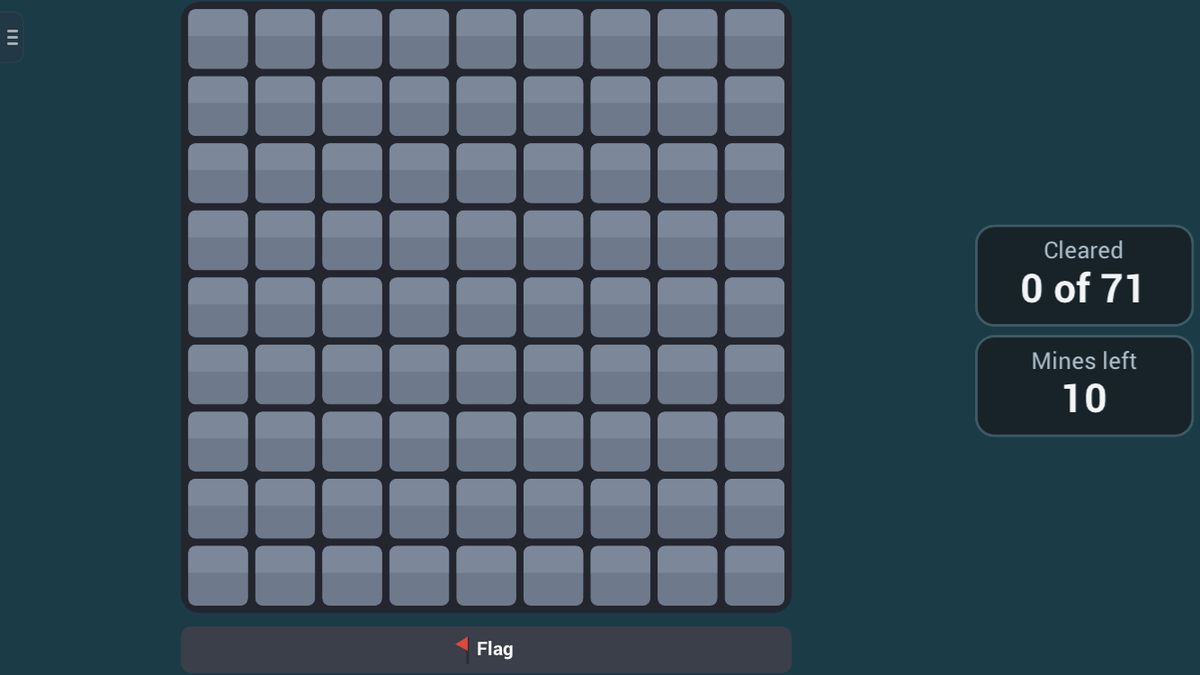
Minesweeper Duel hides ten mines under a field of 81 covered squares, nine across and nine down. Open all 71 safe squares without ever opening a mine. The numbers you uncover are your clues: each tells you how many mines hide next to it.
How to solve it
There are no turns. Tap a covered square to open it. Your first tap is always safe: the mines are placed only after it, never on that square or next to it, so it always opens a patch of the field.
A square with no number has no mines around it, so the app opens its neighbours for you. A square with a number counts the mines among its eight neighbours, diagonals included.
When you are sure a square hides a mine, flag it. Tap the Flag bar under the field. It turns orange, and now each tap plants or removes a flag instead of opening. Tap the bar again to go back to opening squares. A flagged square cannot be opened, and each flag lowers the Mines left count by one.
An example: a 1 touches only one covered square. That square must be the mine, so flag it. Now look at another 1 that also touches this flag. Its mine is found, so every other covered square around it is safe to open.
There is no level to choose and no undo.
Scoring and the end of the game
There are no points. The Cleared count shows how many of the 71 safe squares you have opened.
Alone, no clock pushes you. Clear every safe square and the app tells you how many seconds you took. Open a mine and it explodes, all the mines are shown, and the game is over. Tap New game for a fresh field.
In a duel, each of you gets your own field, the same size with ten mines, because each first tap is different. You see how far your rival has got, but never their field. The first to clear every safe square wins. Open a mine and you lose at once; your rival wins. If you both finish moments apart, the faster time wins; exactly the same time is a draw.
Tips to play better
- Count the covered squares. If a number equals the covered squares around it, they are all mines. Flag them.
- Count the flags. If a number already touches that many flags, its other covered neighbours are safe.
- Learn 1-2-1. Along a straight line of covered squares, numbers reading 1, 2, 1 mean the mines sit beside the two 1s, and the square beside the 2 is safe.
- Leave guesses for last. Sometimes the numbers cannot decide. Open everything they do prove first; a new number often settles it.
Common mistakes
- Forgetting which mode is on. Mean to flag a mine with the bar off, and your tap opens it. Orange means flags.
- Forgetting the diagonals. A number counts all eight neighbours, corners too.
- Trusting a hunch flag. Mines left only counts flags; it cannot tell whether they are right. One wrong flag leads every deduction around it astray.
Playing with family
Minesweeper Duel needs no reading, only counting up to eight and careful looking. Children enjoy feeling like detectives; grandparents like that nothing hurries them when playing alone.
The guided lesson shows the safe first tap, how a blank square opens its neighbours, how to read a number and how to use the Flag bar, and what an explosion and a cleared field look like.
There is no computer opponent. Play alone, or, in the app, race together nearby, each on your own phone or tablet, with no Wi-Fi or internet needed. The browser edition is for one device.
Ways to play
- On your ownPlay alone, whenever you like.
- Play together, nearbyOne-on-one with someone in the same room, each on your own phone or tablet. No Wi-Fi or internet needed. In the Jambolaya app.
- Learn by playingA guided lesson on the real game teaches you the rules one step at a time.
 2048 Race1–2 players
 Klondike1–2 players
 FreeCell1–2 players
 Pyramid1–2 players
 Tri-Peaks1–2 players
 Golf Solitaire1–2 players
 Spider1–2 players
 Mahjong Solitaire1–2 players