 Jambolaya
Letter Storm
How to play
Find as many words as you can in the letter grid before time runs out, tracing through adjacent letters. Longer words score more. The highest total when the clock stops wins.
The difficulty sets the round: Easy gives you 2 minutes and a grid full of common words; Normal gives you 90 seconds; Hard gives you 90 seconds, and only words of 4 letters or more count.
The aim
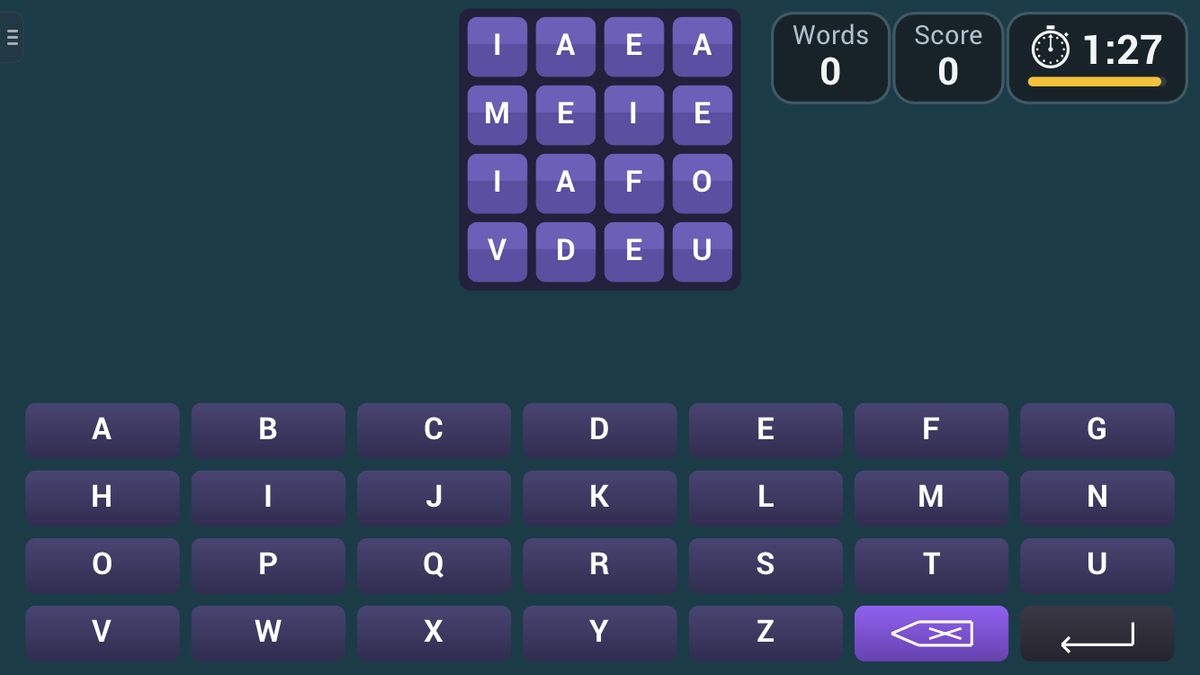
Letter Storm gives you sixteen letters in a square, four across and four down, and a clock. Find as many real words in it as you can before time runs out. Longer words are worth much more.
How to solve it
There are no turns. A word counts when you can spell it by stepping from letter to touching letter: left, right, up, down or diagonally. Each tile may be used only once in a word, but again in your next word.
You do not tap the square itself. Type the word on the keyboard under it, then press the green Enter key. The app checks it at once:
- Nice! means the word scores.
- Not a word means the dictionary does not know it.
- Not on the grid means the letters do not join up as a chain in the square.
- Already found means you have it already. Each word counts once.
A wrong try costs nothing. The delete key fixes a typing slip.
An example: the top row reads C, A, T, S. C touches A and A touches T, so CAT scores. T touches S, so CATS scores as a second word. If an R sits just below the A, STAR works too: S, T, A, R.
Before you start, choose a level. Easy gives you 2 minutes and a square packed with common words. Normal gives you 90 seconds. Hard also gives you 90 seconds, and only words of four letters or more count; Enter stays dark until your word is long enough. The letters and the dictionary follow the app's language.
Scoring and the end of the game
Words score by length: three or four letters earn 1 point, five letters 2, six letters 3, seven letters 5, and eight letters or more 11. The app shows how many words you have found and your score as you go.
Alone, the game ends when the clock reaches zero, and the app shows your final score. Tap New game for a fresh square.
In a race, both players get the identical square and the same clock, at the level the player who invites picks. You see your rival's score, but never their words. When time runs out, the higher score wins. Equal scores are a draw.
Tips to play better
- Go long. One eight-letter word is worth eleven short ones. When you find a word, try to stretch it.
- Add endings. A found word often grows: an S for a plural, or ED, ER or ING if those letters sit next to the end.
- Walk around one letter. Pick a tile and read every letter around it. Pairs like TH, ST or CH often start several words.
- Try your hunches. Wrong guesses cost no points, so if a word might be there, type it.
- Rearrange. STONE, NOTES and TONES use the same five letters. If the tiles link up in more than one order, each order is a new word.
Common mistakes
- Using one tile twice. A word with two Es needs two different E tiles that fit the chain.
- Jumping a gap. Letters that are both in the square but do not touch cannot be joined.
- Retyping old words. In a hurry it is easy to enter a word twice. It earns nothing and costs time.
Playing with family
Letter Storm is a reading and spelling game, so it suits children who can read short words, alone or beside a parent. Easy gives more time and plenty of everyday words; Hard keeps strong spellers hunting long ones.
The guided lesson shows how letters link, how to type a word and press Enter, and how points grow with length.
There is no computer opponent. Play alone, or, in the app, race together nearby, each on your own phone or tablet, with no Wi-Fi or internet needed. The browser edition is for one device.
Ways to play
- On your ownPlay alone, whenever you like.
- Play together, nearbyOne-on-one with someone in the same room, each on your own phone or tablet. No Wi-Fi or internet needed. In the Jambolaya app.
- Learn by playingA guided lesson on the real game teaches you the rules one step at a time.
 Word Grid1–4 players
 Crate Push1–2 players
 Shape Swap1–2 players
 Letter Ring1–4 players
 Star Battle1–4 players
 Lot Slide1–4 players
 Color Sort1–4 players
 Join the Pairs1–4 players