 Jambolaya
Cross Sums
How to play
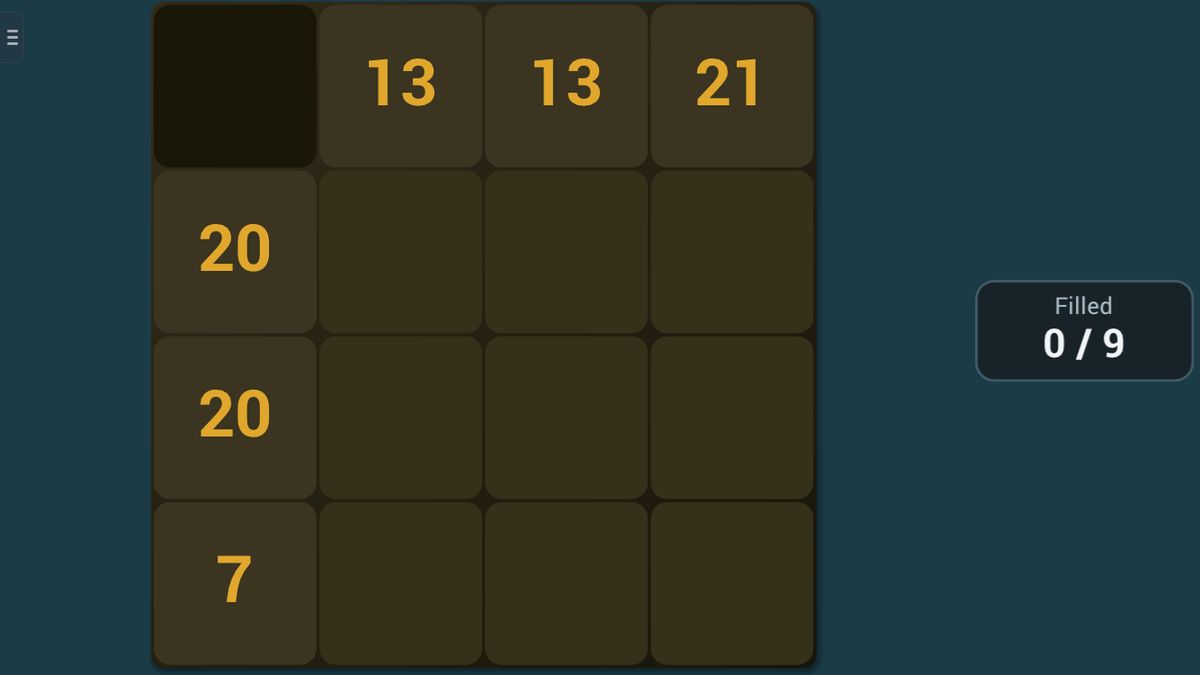
A number crossword. Fill each run — a row or column of three cells — with digits that are all different and add up to the clue shown at its start. Tap a cell to cycle its digit. Complete the grid to finish.
The aim
Cross Sums is a small number crossword. The top row and left column of the 4×4 board hold clues; the other nine squares, a 3×3 block, start empty. Fill each one with a digit from 1 to 9, so every row adds up to the clue on its left and every column to the clue on top. The three digits in any row or column must all be different.
How to solve it
There are no turns. Tap an empty square and a 1 appears. Each further tap adds one, up to 9, and one more tap empties the square again. So going from 3 back to 2 means tapping all the way round.
A digit may appear more than once on the board, as long as it is never twice in the same row or column.
An example: a row's clue is 7. The only three different digits that make 7 are 1, 2 and 4. Now take the square in that row whose column clue is 20. If it held 1, the column's other two squares would need 19, but the biggest pair, 9 and 8, only makes 17. A 2 would leave 18, still too much. So that square must be 4.
The app shows how many of the nine squares you have filled. If all nine are full but a sum is wrong, nothing ends; keep checking. There are no difficulty levels. Each board is new, and New game in the corner menu deals another.
Scoring and the end of the game
There are no points. The game ends the moment every row and column adds up to its clue with no repeated digit. Any grid that fits all six clues counts, even if it is not the one the app had in mind.
Alone, no clock pushes you. When you finish, the app tells you how many seconds you took.
In a race, both players get the identical clues. You see how far your rival has got, but never their digits. The first to complete a correct grid wins, and the game ends for both. If you finish moments apart, the faster time wins; exactly the same time is a draw.
Tips to play better
- Start with the extreme clues. 6 can only be 1, 2 and 3; 7 only 1, 2 and 4; 23 only 6, 8 and 9; 24 only 7, 8 and 9.
- Use the crossing square. Every square sits in one row and one column, and its digit must suit both clues, as in the example.
- Finish a run with a subtraction. Once two squares of a run are filled, the third is the clue minus those two. Check it is 1 to 9 and not a repeat.
- Leave middle clues for later. A clue like 15 can be made in many ways.
- Decide before you tap. Going back means going all the way round, so work out the digit first.
Common mistakes
- Repeating a digit in a run. 4, 4 and 1 make 9, but not in one row or column.
- Thinking a digit can only appear once on the whole board. It can appear in different rows and columns.
- Tapping once too many. Past 9 the square goes blank; keep tapping to come back round.
Playing with family
Cross Sums is a friendly way to practise adding small numbers. A child who can add three digits can join in, and a grandparent can help with the reasoning.
The guided lesson shows how the clues work, the no-repeat rule, how tapping changes a digit, and why extreme clues are the place to start.
There is no computer opponent. Play alone, or, in the app, race together nearby, each on your own phone or tablet, with no Wi-Fi or internet needed. The browser edition is for one device.
Ways to play
- On your ownPlay alone, whenever you like.
- Play together, nearbyOne-on-one with someone in the same room, each on your own phone or tablet. No Wi-Fi or internet needed. In the Jambolaya app.
- Learn by playingA guided lesson on the real game teaches you the rules one step at a time.
 Bridges1–2 players
 Tower Stack1–6 players
 Tangram1–2 players
 Pipes1–2 players
 Jigsaw1–2 players
 Tile Slide1–2 players
 Flood1–2 players
 Blackout1–2 players