 Jambolaya
Bridge
How to play
Four players in two partnerships — you and the player across vs the other two. All 52 cards are dealt, 13 each.
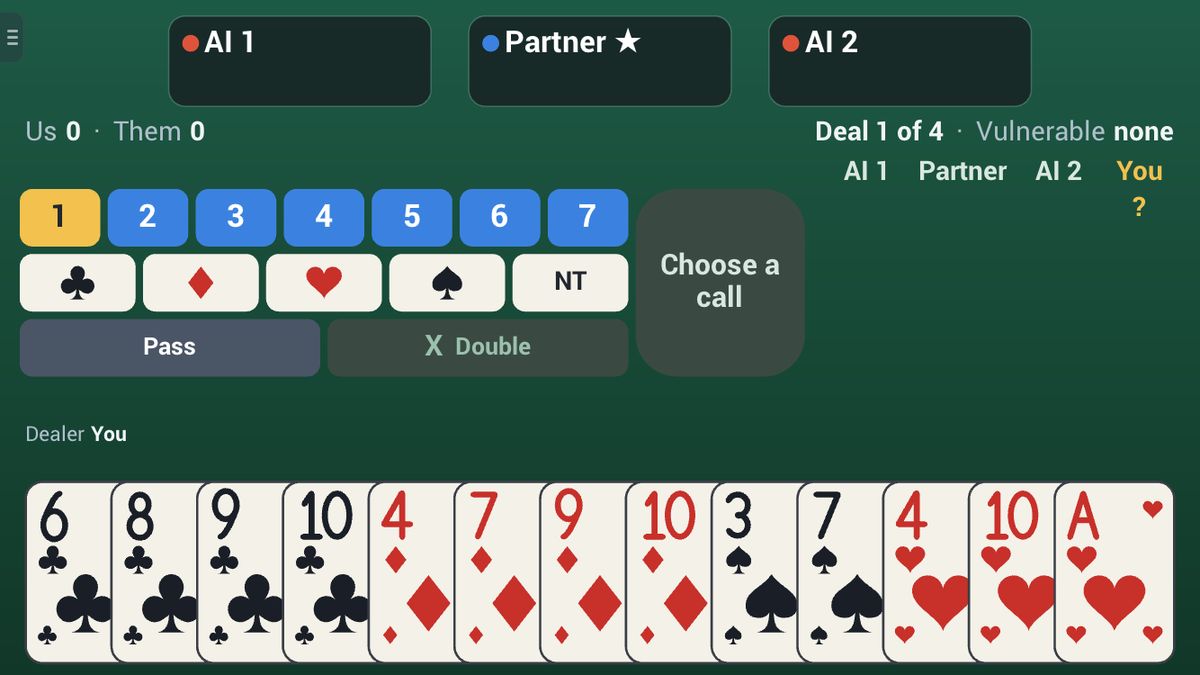
First comes the auction: starting with the dealer and going left, each player passes or bids a level from 1 to 7 (the tricks to win above six) with a trump suit or NT (no trumps).
Suits rank clubs, diamonds, hearts, spades, then NT, and every bid must beat the one before. You may double an opponent's bid, and the doubled side may redouble. Three passes in a row end the auction; if all four pass at the start, the cards are dealt again.
The last bid is the contract, and the partner who first named its suit is the declarer. The player on the declarer's left leads, then the declarer's partner puts their cards face up as the dummy, and the declarer plays both hands.
Follow the led suit if you can, otherwise play anything; the highest trump wins the trick, or the highest card of the led suit.
If the declaring side takes six tricks plus its level, it scores 20 a trick in clubs or diamonds, 30 in hearts or spades, and 40 for the first NT trick and 30 for the rest.
Reaching 100 in one contract makes a game; bidding and making 6 is a small slam and 7 a grand slam, both with big bonuses. If the contract fails, the defenders score for every trick short — more when the declarers are vulnerable or doubled.
Chicago is four deals, each scored on its own, with a game bonus of 300 (500 when vulnerable) or 50 for a smaller contract. Rubber is won by the first side to make two games, for a bonus of 700, or 500 if the other side has one.
There is no bonus for holding honours.
The aim
Bridge is for four players in two teams: you and the player across from you are partners. First you bid, promising how many tricks your side will take. Then you play to keep that promise, or to break theirs.
How a turn works
All 52 cards are dealt, 13 each.
The bidding. Starting with the dealer, each player in turn makes one call:
- A bid is a number and a suit, like 2 hearts. The number means tricks above six, so a bid of 2 promises 8 tricks. NT means no trumps.
- Every bid must be higher than the last: more tricks, or the same number with a higher suit. The order is clubs, diamonds, hearts, spades, then NT.
- Pass means nothing to add. Double raises the stakes on the other side's bid; they may Redouble.
Three passes in a row end the bidding. The last bid is the contract, and its suit becomes trump (none in NT). If all four pass at the start, the cards are dealt again.
The play. On the winning side, the partner who first named the contract's suit is the declarer. The player on the declarer's left leads. Then the declarer's partner lays their hand face up as the dummy, and the declarer plays it too.
Follow the led suit if you can; if not, play anything, even a trump. The highest trump wins the trick, or else the highest card of the led suit.
A small example: counting Ace 4, King 3, Queen 2 and Jack 1, you have 14 points and five hearts. You bid 1 heart, your partner raises to 4 hearts, and everyone passes. Your side needs ten tricks, with hearts as trump.
Scoring and the end of the game
Make your contract and every bid trick scores: 20 in clubs or diamonds, 30 in hearts or spades, and in NT 40 for the first and 30 after. Reaching 100 in one contract makes a game, worth a big bonus. Bidding and making 6 or 7 is a slam, worth even more. Fall short and the other side scores for every missing trick. Being doubled or vulnerable makes bonuses and penalties bigger.
Choose the scoring before you start:
- Chicago, four deals. Each deal is scored on its own: a game adds a bonus of 300, or 500 when vulnerable, and a smaller contract 50. Nobody is vulnerable on deal one, the dealer's side on the second and third, and both sides on the fourth.
- Rubber, best of three games. Smaller contracts add up toward 100, and a side that has won a game is vulnerable. The first side to win two games earns 700, or 500 if the others have one.
The side with more points at the end wins; equal scores are a draw. Holding honours earns no bonus.
Tips to play better
- With about 12 high-card points or more, open the bidding; with less, pass.
- Aim for a trump suit in which you and your partner hold eight or more cards together.
- The computer bids plainly, with no secret codes. When your partner bids hearts, they really have hearts.
- As declarer, count the tricks you need, then lead trumps early to draw out the opponents' trumps.
Common mistakes
- Forgetting that the number of a bid means tricks above six.
- Bidding too high: a failed contract gives the other side points.
- Trumping a trick your partner was already winning.
Playing with family
Bridge takes some learning, but it lasts a lifetime, and a partner makes it social.
In Jambolaya you play with a computer partner against two computer opponents, at Easy, Normal or Hard. If your partner declares, they play your cards. A guided lesson takes you through bidding, playing the dummy and trumps. In the app, four people can also play together nearby, each on their own phone or tablet, with no Wi-Fi or internet needed.
Ways to play
- Against the computerPlay on one device against a computer opponent.
- Play together, nearbyWith family and friends in the same room: up to 4 players, each on their own phone or tablet. No Wi-Fi or internet needed. In the Jambolaya app.
- Learn by playingA guided lesson on the real game teaches you the rules one step at a time.
 Sevens1–7 players
 Whist1–4 players
 Knockout Whist1–7 players
 Oh Hell1–7 players
 Euchre1–4 players
 Sergeant Major1–3 players
 Ninety-Nine1–3 players
 Pinochle1–4 players