 Jambolaya
Bowling 3D
How to play
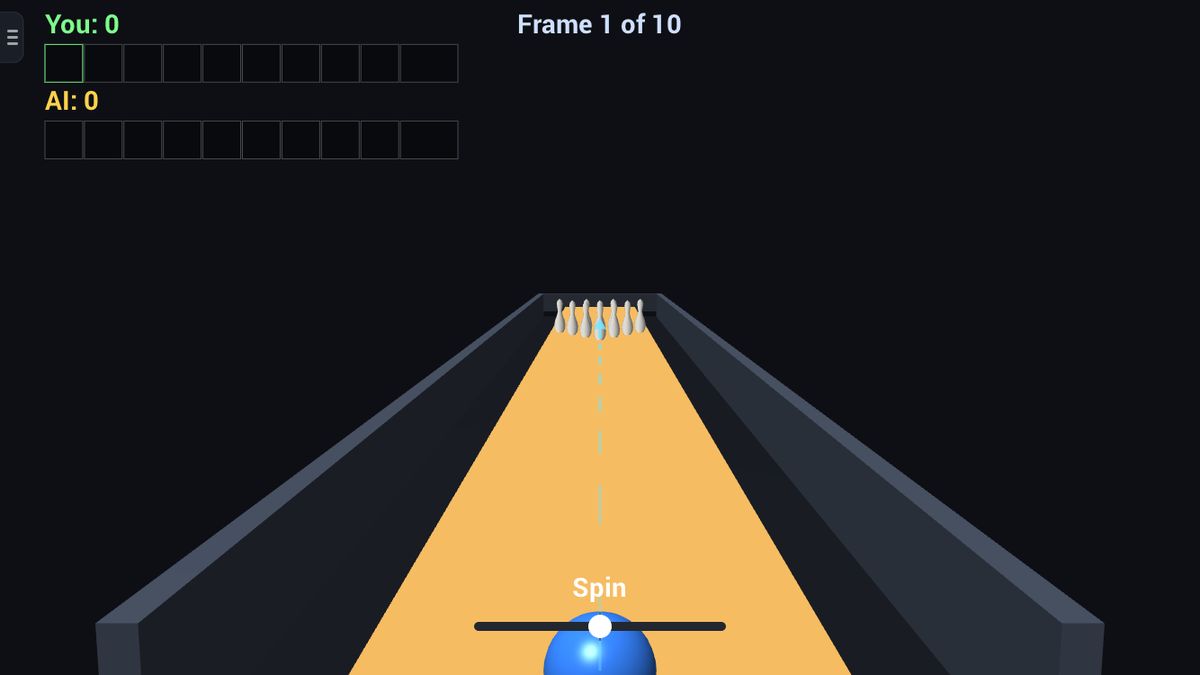
Ten frames on a real 3D lane. Drag the ball along the foul line to place it, slide across the upper lane to swing the aim arrow, and drag the spin meter to set a left or right hook — then swipe up on the ball to bowl, and the speed of your swipe is the power.
Down all ten pins with the first ball for a strike, or with two for a spare; both earn bonus pins from the throws that follow. The highest total after ten frames wins.
The aim
Bowling 3D puts a ten-pin lane on your screen. Two players take turns rolling a ball at ten pins, ten frames each. Every pin is a point, strikes and spares earn bonus pins, and the higher total wins.
How a turn works
Your turn is one frame: up to two balls to knock down all ten pins. Then the other player bowls a frame.
- Place the ball. Drag the ball left or right along the foul line.
- Aim. Slide your finger across the upper part of the lane. A dashed line shows where the ball will go.
- Add spin. Drag the spin meter near the bottom. Right spin curves the ball right as it nears the pins, left spin curves it left, and the aim line bends to show it.
- Bowl. Swipe up on the ball. A quick, firm swipe rolls a fast ball; a slow, short one rolls a gentle ball. A swipe that leans sideways moves the aim a little.
Pins still standing are set back on their spots for your second ball.
A small example. Your first ball knocks down 7 pins, leaving three on the right. You move the ball over, aim at the middle one of the three, and knock them all down. That is a spare.
Scoring and the end of the game
- If pins are left after two balls, the frame scores the pins you knocked down.
- A strike is all ten with the first ball. The frame ends at once and scores 10 plus your next two balls.
- A spare is all ten with two balls. It scores 10 plus your next ball.
- In the tenth frame, a strike or a spare earns extra balls, up to three in all.
The score sheet marks a strike X and a spare /. Say you make a spare in frame one, then roll 6 and 2. Frame one is worth 10 + 6 = 16, frame two adds 8, and your total is 24. Twelve strikes in a row make a perfect 300.
When both players have bowled ten frames, the higher total wins. Equal totals are a draw.
Tips to play better
- Aim for the pocket, not the nose. The pocket is the gap just beside the head pin. A ball that hits the head pin full on leaves pins standing; a ball into the pocket can strike.
- Swipe firmly. A slow ball bounces off the pins and leaves some up, even from the pocket.
- Use a little hook. A small spin that curves the ball into the pocket makes strikes easier. The aim line expects a firm swipe, so a softer swipe curves more than it shows.
- For a spare, aim at the pin nearest the middle of what is left. With a wide split, pick one side; a ball through the gap gets nothing.
Common mistakes
- Rolling straight at the head pin every time.
- Swiping slowly to be careful, so the ball arrives weak.
- Turning the spin right up, so the ball curves past the pocket.
- Letting the swipe slant without meaning to.
Playing with family
Everyone understands bowling: roll the ball, knock down the pins. Children swipe and cheer, older players work on the pocket, and the score sheet adds up the bonus pins for you.
In Jambolaya you can play against the computer. Choose Easy, Normal or Hard, who bowls first, and a single game or a best of 3 or 5. On Easy the computer rolls a soft, straight ball and often misses the pocket. On Hard it throws a firm hook and strikes often.
In the app you can also play together nearby, each on your own phone or tablet, with no Wi-Fi or internet needed. The browser edition plays on one device.
Ways to play
- Against the computerPlay on one device against a computer opponent.
- Play together, nearbyOne-on-one with someone in the same room, each on your own phone or tablet. No Wi-Fi or internet needed. In the Jambolaya app.
 Mini-Golf 3D1–2 players
 Cannon Battle1–2 players
 Star Strikers1–2 players
 Air Hockey1–2 players
 Carrom1–2 players
 Crokinole1–2 players
 Prism Rush1–4 players
 Fruit Rush1–2 players